
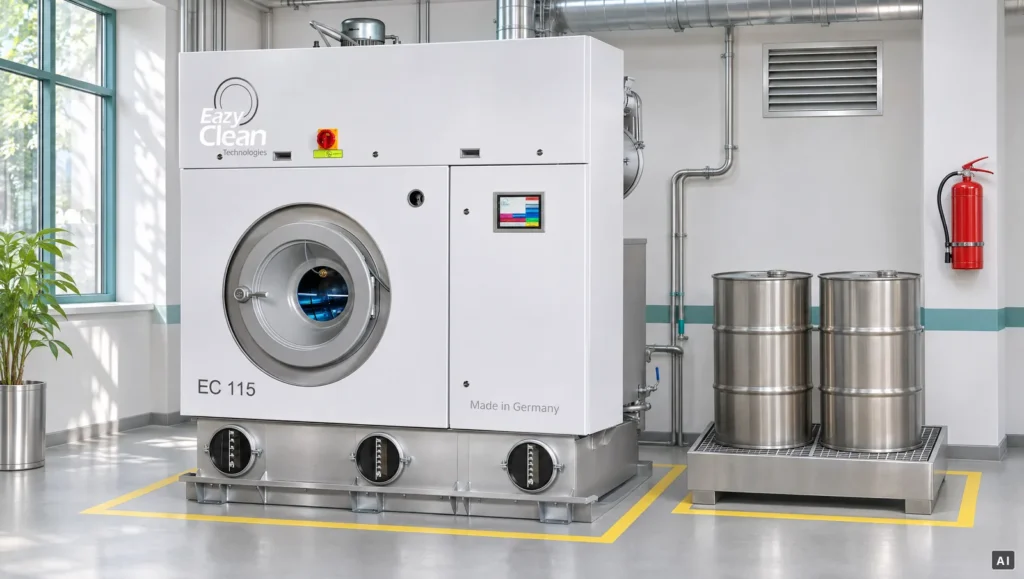
Key takeaways
- Choose the solvent first. It decides machine class, fire safety, cycle time, the care labels you may accept and the waste you generate.
- Perchloroethylene cleans hardest and is non-flammable, but it is classified as probably carcinogenic (IARC Group 2A) and regulation is moving away from it.
- Hydrocarbon is gentler on fabrics and trims, needs longer cycles and is a combustible liquid. That is why hydrocarbon machines distil under vacuum.
- Care labels: P allows perc and the solvents under F, F allows hydrocarbon only. A hydrocarbon shop can accept both.
- Switching an existing shop almost always means a new machine and regulated disposal of residual perc.
Most equipment enquiries arrive in the wrong order. Someone asks for a quote on a hydrocarbon dry cleaning machine, or on a perc machine, and only afterwards works out whether that solvent suits the garments they will be handed, the building they have already leased, and the rules their regulator applies. The solvent decides machine class, fire-safety requirements, cycle time, the care labels you may accept, and the waste you generate.
This is a comparison, not a sales page. EazyClean Technologies builds hydrocarbon machines in Herten, Germany, and that bias will be visible. Several sections below argue against us.
What a dry cleaning solvent has to do
Dry cleaning is not dry. It replaces water with an organic solvent that dissolves fats, oils and greases without swelling natural fibres, felting wool or bleeding dyes. The crude measure of solvent strength is the Kauri-Butanol value (KB): higher means more dissolving power. On figures published by Laundry and Cleaning News, perc sits at about 90, hydrocarbon at 30, cyclosiloxane at 20. That number explains most of what follows. A high-KB solvent strips oily soil quickly — and also strips fabric finishes, the yarn oils that give silk its handle, and the adhesives holding beads and trims. A low-KB solvent is gentle on the garment and slow on the stain, shifting work to the spotting table and a longer wash.
Perchloroethylene: the incumbent, and why it is receding
Perchloroethylene vs tetrachloroethylene is not a comparison. They are one compound, CAS 127-18-4, along with tetrachloroethene, PCE and PERC — all listed as synonyms in IARC Monographs Volume 106. If a datasheet, a permit and an insurance policy use three different words, they still describe one liquid.
Why it became the standard
Perc is the strongest common textile solvent, boils at 121 °C, and — decisive for a workshop on a high street — has no flash point: PubChem, citing NFPA's fire protection guide, records "no flash point in conventional closed tester". A perc machine cannot ignite its own solvent, which is why regulators tolerated perc plants under apartments for six decades. The qualifier: NIOSH calls perc noncombustible but notes it "decomposes in a fire to hydrogen chloride and phosgene".
It is also fast: in a DLI-sponsored comparison written up by American Drycleaner in September 2013, perc showed a total cycle of about 45 minutes, the shortest of six solvents tested.
The case against it
IARC classifies perc Group 2A, probably carcinogenic to humans (Volume 106, 2014), the human signal being excess bladder cancer among dry cleaning workers. The US National Toxicology Program has listed it as "reasonably anticipated to be a human carcinogen" since 1989, and the EU gives it a harmonised CLP classification of Carc. 2, H351. Ceballos and colleagues (Frontiers in Public Health, March 2021) note that neurotoxicity is the most sensitive endpoint, with deficits in reaction time and visual memory measurable around 8 ppm.
The second problem outlives the business. Perc is a dense non-aqueous phase liquid: heavier than water, slow to degrade, and it sinks. The Wisconsin DNR describes the mechanism — spills, sewer disposal and dumping contaminated soil, groundwater and sewers beneath historical dry cleaners; the plume migrates under gravity; vapours enter buildings through foundation cracks, odourless and colourless. The State Coalition for Remediation of Drycleaners' ten-year report, hosted by US EPA and dated October 2008, counted roughly 30,000 drycleaner sites nationally, about 22,500 of them contaminated (as of 2008). If you are buying an existing shop, that deserves a soil investigation before the contract.
The direction of regulation — and why no single date is safe
There is no worldwide perc deadline — only a direction, and dated, jurisdiction-specific steps:
- US federal air rule. Under 40 CFR Part 63 Subpart M, co-residential perc dry cleaners — those in the same building as occupied residences — had to cease perc use after 21 December 2020.
- US, TSCA. EPA's final rule for PCE (published 18 December 2024) sets a ten-year phaseout in dry cleaning and prohibits use in newly acquired machines after six months, retiring older machine generations first. Secondary summaries put the milestones at third-generation machines after 20 December 2027 and fourth- and fifth-generation after 19 December 2034 — reported, not settled, since EPA reopened comment in July 2025 and extended several workplace-monitoring dates in July 2026.
- California. Amendments to CARB's Dry Cleaning ATCM, adopted 25 January 2007, phased out perc machines by 1 January 2023.
- France. The arrêté du 5 décembre 2012 (ICPE 2345), in force from 1 March 2013, barred new perc machines in premises adjoining third-party occupied premises and phased out the rest by age, the newest running at most to 1 January 2022.
- Sweden. Perc is prohibited in consumer products but professional use has continued; the Swedish Textile Service Association stated in 2011 that there is no ban.
- Germany. No siting ban exists. The 2. BImSchV permits tetrachloroethene as the only halogenated dry cleaning solvent (§ 2), caps residual solvent in drying air at 2 g/m³ behind a door interlock (§ 4), and — the provision that actually pushed machines out of residential buildings — obliges an operator whose neighbours' indoor air exceeds 0.1 mg/m³ perc as a seven-day mean to fix it within six months (§ 16(2)). A performance limit, not a prohibition.
- EU level. Perc is not banned and not restricted under REACH for dry cleaning, nor on the Authorisation List. The bans are national, not European.
Those are separate authorities moving in one direction at different speeds. Anyone who says "perc is banned" or "perc is fine" without naming your jurisdiction is guessing. Ask your competent authority in writing, and date the answer.
Hydrocarbon: the current default, and its honest limits
Hydrocarbon solvent — HCS in trade shorthand, sold as DF-2000, EcoSolv, Isopar and equivalents — is a synthetic, hydrotreated aliphatic fluid, essentially free of aromatics, and the safety data sheets agree closely. DF-2000 gives a boiling range of 185–211 °C and a flash point above 61 °C (ASTM D-93), classified H227, combustible liquid. EcoSolv gives 189–208 °C and 61.1 °C, which Chevron Phillips states places it in NFPA Class IIIA (at or above 60 °C, below 93 °C). DF-2000's sales specification guarantees only a 60 °C minimum, exactly on the class boundary — so the safety data sheet for the drum you buy is the binding document.
What it does well. At KB ≈ 30 it is gentle: little damage to delicate trims, beading, sequin adhesives and solvent-sensitive dyes, and it leaves fabric finishes and the yarn oils that give fine silk its handle intact. Garments come back without the smell customers associate with dry cleaning, and it carries no halogen.
What it does less well. The same low KB means slower solvation of oily soil. The DLI panel gave hydrocarbon a total cycle of 50–65 minutes against perc's roughly 45 — 20 to 40 per cent longer per load. Drying peaks around 60–65 °C rather than the 40 °C a modern perc machine manages.
The constraint worth raising early: hydrocarbon is combustible. Perc does not. NIOSH set this out in Hazard Control 17 (DHHS (NIOSH) 97-155, October 1997): petroleum-based dry cleaning offers reduced toxicity, reduced inhalation exposure and lower operating cost, against fire hazard, extended drying times, reduced effectiveness on oil and grease, and higher insurance costs. Machine design has moved on since 1997. The KB value and the flash point have not.
The trade-off, stated plainly
| Perchloroethylene | Hydrocarbon | |
|---|---|---|
| Grease and oil stains | Stronger | Weaker |
| Drying time | Shorter | Longer |
| Fire safety | No fire risk from the solvent | Combustible; building rules constrain where the machine may stand |
| Inhalation exposure for staff | Higher | Lower |
Row three is a purchasing constraint, not a footnote: fire-class requirements decide whether the machine may stand in a basement, under flats or in a shopping centre unit. Get the fire officer's view before you sign the lease or the order.
Siloxane (D5): gentle, and now on an EU clock
GreenEarth is a licensed process built on decamethylcyclopentasiloxane (D5), flash point around 76.6 °C, running in Class IIIA machines with a 60-minute cycle on the DLI panel and an affiliation fee the other solvents did not carry. The strength is fabric care: at KB ≈ 20 it is the gentlest mainstream solvent, with low surface tension, minimal dye bleed and very little effect on trims — and correspondingly little effect on stains, so a siloxane operation is spotting-led.
The open question is European regulation. D5 is subject to an EU REACH restriction: Commission Regulation (EU) 2024/1328 extended Annex XVII entry 70 to cover D4, D5 and D6, and dry cleaning is among the uses it addresses. Check the current status of that restriction, and any derogation for dry cleaning in closed systems, in the Official Journal text of entry 70 before committing capital.
Outside the EU the picture differs: GreenEarth points to Environment Canada's finding that D5 poses no danger to the environment, while the Frontiers review calls the carcinogenicity data equivocal.
SOLVONK4: the modified alcohol
SOLVONK4 from Kreussler is a single pure substance rather than a blend: dibutoxymethane (butylal), CAS 2568-90-3, over 99 per cent pure. Kreussler gives a Pensky-Martens closed-cup flash point of 62 °C, a boiling point of 180.5 °C, and no CLP hazard classification in the EU.
Its distinguishing claim is amphiphilicity: it dissolves both lipophilic and water-soluble soil, narrowing the gap between dry and wet cleaning. On the DLI panel it ran 62–70 minutes.
Two caveats. Kreussler itself states that existing machines generally cannot be converted, for technical and legal reasons, and there is no dedicated ISO 3758 symbol for the system. Most published data comes from the manufacturer — ask for a trial on your own mix.
Professional wet cleaning: the alternative that is not a solvent
Wet cleaning uses water with specialised detergents, controlled drum action and low-temperature drying. NIOSH's assessment is that it handles 30 to 70 per cent of garments traditionally dry cleaned, with fewer health and safety concerns and low operating cost — against real disadvantages: it does not replace dry cleaning entirely, it can cause shrinkage and fabric deterioration, some stains are harder to remove, and it is labour-intensive. It generates no hazardous solvent waste, the strongest single argument in its favour. Honest framing: an excellent second machine, a poor sole machine for a shop that takes whatever walks through the door.
Care symbols: where the solvent choice meets the counter
The circle on a care label is an instruction to the professional cleaner, defined in ISO 3758, and it determines what you can accept once your machine is installed.
| Symbol | Meaning | Hydrocarbon shop? |
|---|---|---|
| Circle with P | Professional dry cleaning in tetrachloroethene and in all solvents listed for symbol F | Yes |
| Circle with F | Professional dry cleaning in hydrocarbons (distillation range approx. 150–210 °C) | Yes |
| Circle with W | Professional wet cleaning | Only with wet cleaning equipment |
| Crossed-out circle | Do not dry clean (a crossed-out W circle means do not wet clean) | No |
| One bar beneath | Mild process: reduced mechanical action, and/or moisture, and/or drying temperature | Yes, gentle programme |
| Two bars beneath | Very mild process | Yes, gentlest programme |
Read the first two rows together. P includes F; F does not include P. A garment labelled P may be cleaned in perc or hydrocarbon; one labelled F in hydrocarbon only.
The commercial consequence: a hydrocarbon shop can accept both P and F garments; a perc shop must refuse or subcontract the F items. ISO 3758 was revised in 2023, adding new solvents to both symbols, including D5.
What the solvent means for how the machine is built
A hydrocarbon dry cleaning machine is not a perc machine with different liquid in it.
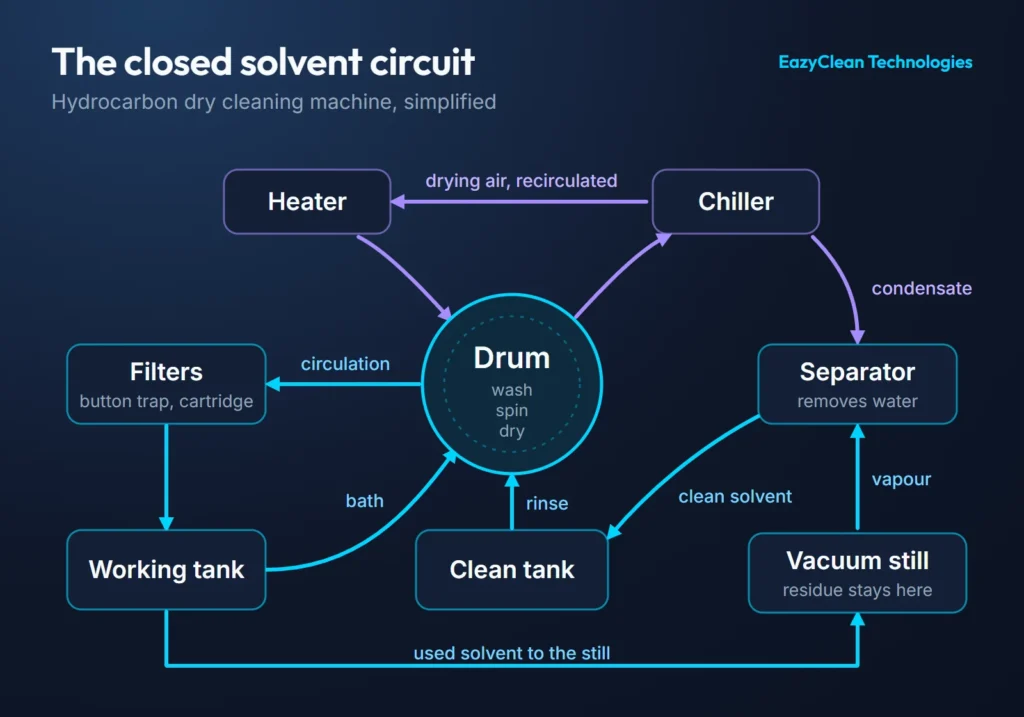
Flash point class. In NFPA terms hydrocarbon is a combustible liquid, not a flammable one — flammable means Class I, and Class I solvents are barred from dry cleaning outright. Germany has no equivalent label since VbF Gefahrklasse A III (55–100 °C) was repealed in 2003; duties now come from the Gefahrstoffverordnung, including the explosion protection document under § 6(9), and from DGUV Regel 100-500 Chapter 2.14 — no ignition sources in the installation room, control of electrostatic charging, conductive footwear. Machines are built to EN ISO 8230-3. Note that the
- BImSchV covers halogenated solvents only, so a hydrocarbon machine falls outside it entirely.
Vapour and oxygen control. Most trade writing has this backwards. Under NFPA 32 § 8.5.2.1.1, automatic extinguishing systems and self-closing hatches are not required if the equipment holds oxygen below 8 per cent by volume, or solvent vapour below 25 per cent of the lower explosion limit, or vapour at or below 60 per cent of the LEL with interlocks to NFPA 69. So nitrogen inerting is not mandatory — it is one route among three. Some machines are designed to stay below 25 per cent of the LEL during drying, the second route; nitrogen generators take the first. Ask a supplier which route its machine takes, and what happens if the sensor fails.
Vacuum distillation — this one is mandatory. NFPA 32 § 8.5.2.2.2 is one sentence: "Stills shall be designed for operation based on the vacuum principle." A cut boiling at 185–211 °C cannot be distilled at atmospheric pressure while keeping the liquid below its roughly 61 °C flash point, and atmospheric distillation would thermally decompose most of the contaminants. At 50–100 mbar it works. A vacuum still is baseline compliance, not a premium feature.
Materials — a durability choice, not a rule. NFPA 32 sets no material requirement here; "stainless" does not appear in it, and even the perc chapter permits carbon steel. At EazyClean Technologies all solvent-carrying components are austenitic stainless steel — V2A/V4A, equivalent to 304/316 — a large part of why the design life is 20 to 30 years. Ask every supplier what its solvent-carrying components are made of.
Switching an existing shop: what actually happens
You will almost certainly need a new machine. Perc machines are not designed for a combustible solvent, and the alternatives are not drop-in replacements. The Frontiers review is blunt: the only true drop-in substitute is n-propyl bromide, a potent neurotoxicant and likely carcinogen. Retrofits are marketed, but treat any conversion offer as requiring written approval from the machine maker, the solvent supplier, your insurer and your fire authority — all four.
Residual stock and the old machine are a regulated project. Leftover perc, still bottoms, spent filters, separator water and contaminated lint are hazardous waste in most jurisdictions and need a licensed handler with a manifest trail. Washington State's Department of Ecology is explicit that separator water must never go down a drain.
Throughput dips before it recovers. Plan on 20 to 40 per cent longer cycles; whether that costs capacity depends on drum size and shift pattern. A payback period is only meaningful if it is based on your load counts, garment mix and opening hours.
The process changes, not just the machine: more pre-spotting, different detergent chemistry, a longer bath, staff retraining. And the paperwork changes direction — you lose the chlorinated-solvent air-permit regime and gain fire and explosion-protection obligations.
Hydrocarbon dry cleaning machine manufacturers: who is in this market
Anyone searching for hydrocarbon dry cleaning machine manufacturers will find a small field of suppliers. Model ranges change faster than any article can track, so compare suppliers on criteria you can check rather than on reputation. When comparing suppliers, ask:
- Service and parts. How long has the parts and service network existed in your region, and how quickly can a technician be on site? That decides how long your machine stands idle when something fails.
- Solvent approval. Which current model is approved for your solvent? Breadth of range and depth of service are two separate questions; ask both.
- Fire-safety route. Does the machine limit oxygen (nitrogen inerting) or vapour concentration (below 25 per cent of the LEL during drying)? Ask for the figure in writing, and what happens if the sensor fails.
- Distillation. Is the still a vacuum still? Some designs dispense with a conventional still in part of their range — whether that suits you depends on your soil load.
- Materials. Which components carry solvent, and what are they made of?
- Logistics. Where is the machine built, and where are the spare parts stocked? For buyers far from the factory, parts logistics are a real and underrated cost.
- EazyClean Technologies (Germany). We build hydrocarbon machines only, in Herten, North Rhine-Westphalia. The SMART series starts at EUR 65,770 with the SMART112; the EC series — EC115, EC124, EC135 — starts at EUR 83,990, drums up to 35 kg (list prices as of September 2026, net ex works, excl. VAT). Closed-loop operation with 99.9 per cent solvent recovery, integrated distillation and filtration, 30 measuring points watching every cycle in real time, over 80 programmes, austenitic stainless steel throughout, 20 to 30 year service life. We also sell reconditioned used machines.
Two things that cut against us. A full fit-out is not one machine: you also need a finisher, a spotting table and the extraction your regulations require. And if your work is heavy oily industrial garments and your building allows it, a perc machine may clean it better than anything we build.
FAQ
What is dry cleaning solvent? An organic liquid that dissolves fats, oils and greases without wetting the fibre the way water does, so garments do not shrink, felt or bleed dye. In commercial machines the choices are perchloroethylene, hydrocarbon, siloxane D5 and modified alcohols such as SOLVONK4 — not the spray-on upholstery cleaners sold in bottles.
Is perchloroethylene the same as tetrachloroethylene? Yes. Perchloroethylene, tetrachloroethylene, tetrachloroethene, PCE and PERC name one substance, CAS 127-18-4, listed as synonyms in IARC Monographs Volume 106. "Tetrachloroethene" is the systematic name, "perchloroethylene" the trade name for the same liquid.
Is perchloroethylene banned? Not universally, and any single global date is wrong somewhere. California banned it in dry cleaning from 1 January 2023; US federal rules ended co-residential use after 21 December 2020 and set a phaseout to 2034 now under reconsideration; France ended it in adjoining premises by 2022; Sweden still permits professional use. Ask your regulator and date the answer.
Does a hydrocarbon machine clean as well as perc? Not on heavy grease, if you change nothing else. Hydrocarbon has roughly a third of perc's Kauri-Butanol solvency, so it needs a longer bath, more pre-spotting and the right detergent — the DLI panel put its cycle at 50–65 minutes against perc's 45. On delicate fabrics, trims and fine silk the lower solvency is an advantage.
Can I convert my existing perc machine to hydrocarbon? Assume not. Alternatives to perc are not drop-in replacements, and a perc machine is not built for a combustible solvent. Conversion offers exist but should proceed only with written approval from the machine maker, the solvent supplier, your insurer and your fire authority.
What do the P and F symbols mean for my machine? A circle with P means the garment may be cleaned in tetrachloroethene and in all solvents listed under F. A circle with F means hydrocarbon only. So a hydrocarbon shop can accept both P and F garments, while a perc shop must turn F items away. A bar under the circle calls for a mild process, two bars for a very mild one.
What happens to my leftover perc when I switch? It becomes a waste-handling project. Residual solvent, still bottoms, spent filters, separator water and contaminated lint are regulated waste and need a licensed handler and a manifest trail. Decommissioning the old machine is part of that job.
Sources
- NIOSH: Pocket Guide to Chemical Hazards: Tetrachloroethylene
- PubChem: Tetrachloroethylene
- IARC Monographs, volume 106: Tetrachloroethylene
- National Toxicology Program: 15th Report on Carcinogens: Tetrachloroethylene
- ECHA: Substance infocard: tetrachloroethylene
- Frontiers in Public Health: Ceballos et al. (2021)
- US Environmental Protection Agency: Risk management for perchloroethylene (PCE)
- US Environmental Protection Agency: State Coalition for Remediation of Drycleaners: 10-year report (PDF)
- Bergeson & Campbell: EPA proposes to extend compliance dates for the PCE and CTC rules
- California Air Resources Board: Phase-out of perchloroethylene in dry cleaning
- Légifrance: Circulaire du 16 août 2013 (ICPE 2345)
- Sveriges Tvätteriförbund: No ban on perchloroethylene (2011)
- gesetze-im-internet.de: 2. BImSchV (German)
- gesetze-im-internet.de: GefStoffV § 6 (German)
- DGUV: Regel 100-500, chapter 2.14: operating dry cleaning plants (German)
- EUR-Lex: Regulation (EU) 2024/1328 (REACH, D5)
- NFPA: NFPA 32, Standard for Drycleaning Facilities (PDF)
- Washington State Department of Ecology: Dry cleaners: dangerous waste guidance
- Wisconsin DNR: Dry cleaner environmental response
- ExxonMobil: DF-2000 fluid, safety data sheet (PDF)
- Chevron Phillips Chemical: EcoSolv dry cleaning fluid, safety data sheet (PDF)
- Kreussler Chemie: SYSTEMK4: frequently asked questions
- American Drycleaner: Alternative solvents: which is best for you? Part 1
- Laundry and Cleaning News: Solvents
- Intertek: New version of care labelling standard ISO 3758 published
- Wikipedia: Laundry symbol
More articles
- How to Start a Dry Cleaning Business: Equipment & CostsNovember 16, 2026
- How Much Does a Dry Cleaning Machine Cost? 2026 PricesNovember 16, 2026
- How Does a Dry Cleaning Machine Work? Inside the CycleNovember 16, 2026

