
Key takeaways
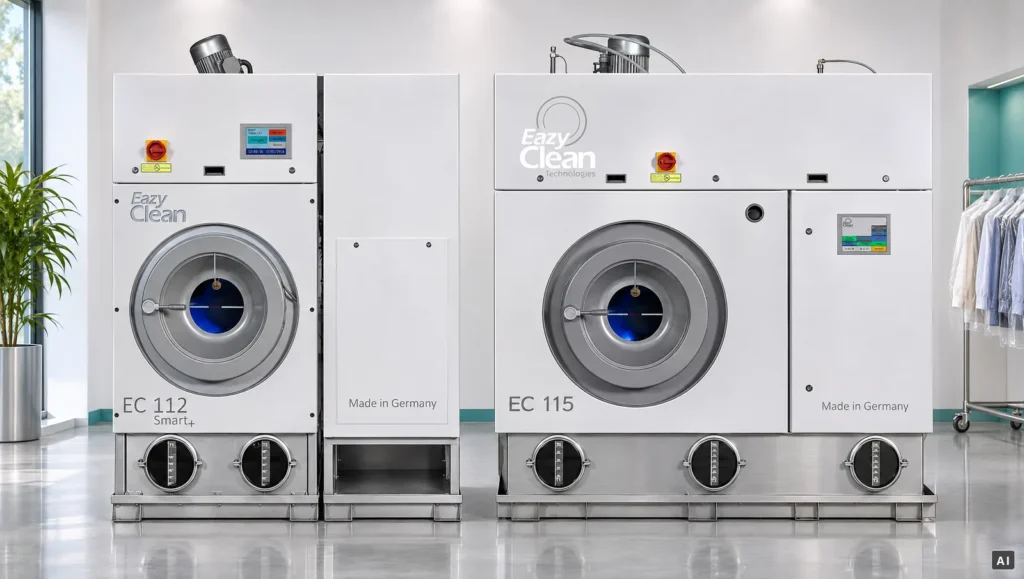
- A new commercial dry cleaning machine starts at roughly 65,000 EUR net ex works. EazyClean Technologies: SMART Series from 65,770 EUR, EC Series from 83,990 EUR (September 2026).
- "Net ex works" excludes VAT, freight, customs, installation, commissioning, training and the first solvent charge unless the quotation lists them.
- A first fit-out also needs a finisher, a spotting table and the required extraction.
- Over twenty years the running costs outweigh the purchase price. Calculate them with your own numbers.
- With used machines, check drum bearings, the control, the solvent history and the documentation.
A new commercial machine starts at roughly 65,000 EUR net, ex works. That is the plain answer to how much does a dry cleaning machine cost. Many suppliers answer with a quote form. We publish our starting prices: the SMART Series starts at 65,770 EUR and the EC Series at 83,990 EUR, both net ex works, as of September 2026. This guide explains what pushes that number up, what you buy alongside the machine, what it costs to run, and how to read a quotation.
First: are you shopping for a home or for a business?
If you searched for a dry cleaning machine for your house or apartment, stop here — this article will waste your time.
There is no household dry cleaning machine. Not an expensive one, not a compact one, none at all. Dry cleaning means dissolving soils in a solvent, distilling it and returning it to a sealed tank; solvent handling brings ventilation, fire-code and permitting duties a dwelling cannot meet. Regulators in several markets have spent years tightening the rules on solvent machines in and near residential buildings, not loosening them (US EPA, dry cleaning NESHAP overview, retrieved 9 September 2026).
What is sold to consumers under that label is three things, none of them dry cleaning:
| Home product | What it does | Public price, 9 September 2026 |
|---|---|---|
| Dryer-activated refresher kit | Damp cloth in a bag, tumbled warm — deodorises, relaxes creases | Dryel At-Home Dry Cleaner Kit, 5 loads: 10.99 USD (Target) |
| Garment steamer | Relaxes fibres; no cleaning at all | 22.99 to 129.95 USD across the Target range |
| Steam closet | Warm humid cabinet, refreshes a worn suit | LG Styler S3WFBN: 1,499 USD on offer, 1,899 USD list (lg.com) |
One thing before you spend anything there: almost nothing is on sale between roughly 250 USD and 1,500 USD. The steamer tier stops, the cabinet tier begins, and the gap is empty.
Everything below is about a commercial dry cleaning machine — floor-standing, plumbed, wired and permitted, for a shop, hotel laundry or industrial cleaner, starting around 65,000 EUR.
Why almost nobody publishes a dry cleaning machine price
This is not paranoia on your part. We checked on 9 September 2026, and the pattern is consistent.
We opened five dealer and marketplace sites that day. A US distributor lists whole machine families and no figures. A second US dealer shows around twenty reconditioned items with zero prices. On a large used-machinery marketplace, the hydrocarbon category held 88 machines, essentially all "Contact Seller for Price". An Italian used-equipment dealer lists eighteen machines by brand, model and capacity, without a number. A German dealer's page for a new premium-range machine says Preis auf Anfrage. No manufacturer site we opened publishes a price. So when you ask how much is a dry cleaning machine and get a form instead of a figure, that is the trade, not you.
Two places on the open web do print numbers: used marketplaces, where a private seller sets whatever they like, and Asian B2B directories. Which is why the only new prices readable without a phone call are Chinese and Indian:
- A Chinese-built machine, 8/10/12/16 kg, perchloroethylene, closed circuit, fully automatic — 5,000 USD per piece, minimum order one (B2B marketplace listing, retrieved 9 September 2026).
- A new 20 kg machine, perchloroethylene, fully automatic, offered by an Indian trader — 500,005 INR (IndiaMART, retrieved 9 September 2026).
- The IndiaMART category page rendered a spread from 35,000 to 1,800,000 INR the same day. Read it with care: at the bottom are locally fabricated hydro-extractors and semi-automatic units, not closed-circuit solvent machines. A 35,000 INR "dry cleaning machine" and an 1,150,000 INR one are not the same class of object, and one range holding both tells you nothing.
All three are listed prices at retrieval, unverified, for machines of undisclosed specification — not comparable with a configured European machine.
The conclusion is not "buy the cheap one". It is that any English-language guide quoting a single typical dry cleaning machine cost is quoting an estimate that no public source supports. We publish our starting prices.
What drives the dry cleaning machine cost
Eight things move the number, roughly in order of weight.
Drum size and capacity in kg. The biggest lever, but not a linear one — see the next section.
Solvent type. Hydrocarbon solvents, perchloroethylene and the alternative fluids each need different tank arrangements, seals, safety concepts and still designs. The machine is built around the solvent; you do not swap it later. Ours run modern hydrocarbon solvents in a fully closed circuit.
Degree of automation. A machine that runs an unattended cycle — dosing, drying, cooling, distilling, monitoring — carries sensors, valves and control that a semi-automatic machine does not. Ours use touchscreen control with automatic soap dosing and more than 80 programmes.
Distillation capacity. Whether distillation is integrated or a bolted-on module, and how many litres per hour it handles, decides whether the still keeps up with your throughput or becomes the bottleneck at three in the afternoon. On the used market, distillation modules show up as separate line items — they are often sold as an extra.
Filtration. Cartridge count, filter type, and how often cartridges are changed. A purchase-price item and a running-cost item at once, so compare it in both columns.
Stainless steel grade. Not decoration: solvent-carrying parts sit in a corrosive environment for decades. We use austenitic stainless steel — V2A/V4A, corresponding to 304/316 — for all of them. Ask any supplier to state the grade in writing; "stainless steel" without a number is not an answer.
Control and monitoring. Ours carry 30 integrated measuring points that monitor every cycle in real time. What that buys is not a nicer screen; it is knowing a cycle has gone wrong while it is going wrong.
Options. Solvent cooling, additional tanks, higher spin speeds, extra distillation, special voltages — and the place where two quotations quietly stop being comparable.
Price bands by capacity
How much does a dry cleaning machine cost at each level? Think in three bands rather than in individual model numbers.
Entry — a single shop, one shift. The smallest sensible commercial size for a retail cleaner: everything a big machine has, in a smaller drum. This is the band people mean when they search for a small dry cleaning machine price, and the surprise is always the same. It is not proportionally cheaper. Control, still, pumps, safety chain and certification effort barely shrink with the drum, so cost per kilogram of capacity is at its worst here. Our SMART Series sits in this band, from 65,770 EUR net ex works, with the SMART112.
Mid-range — a busy shop or a small industrial cleaner. More drum, more distillation, higher spin, more tanks, and a noticeably better cost per kilogram. This is where most first-time buyers who did their throughput arithmetic honestly end up.
Continuous operation — multi-shift, hotel and industrial work. Built for load after load, all day, for years. Drum capacity up to 35 kg in our EC Series, designed for multi-shift operation and comprising the EC115, EC124 and EC135, from 83,990 EUR net ex works.
Which band you belong in is decided by your daily kilograms, not your budget. Take your realistic weekly volume, divide by operating days, divide by the loads you can physically run per day, and you have your minimum drum. Buying one band down means running two cycles where one would do — for twenty years.
Our prices, and what "net ex works" leaves out
As of September 2026:
| Series | Models | From | Basis |
|---|---|---|---|
| SMART Series | SMART112 | 65,770 EUR | net, ex works |
| EC Series | EC115, EC124, EC135 | 83,990 EUR | net, ex works |
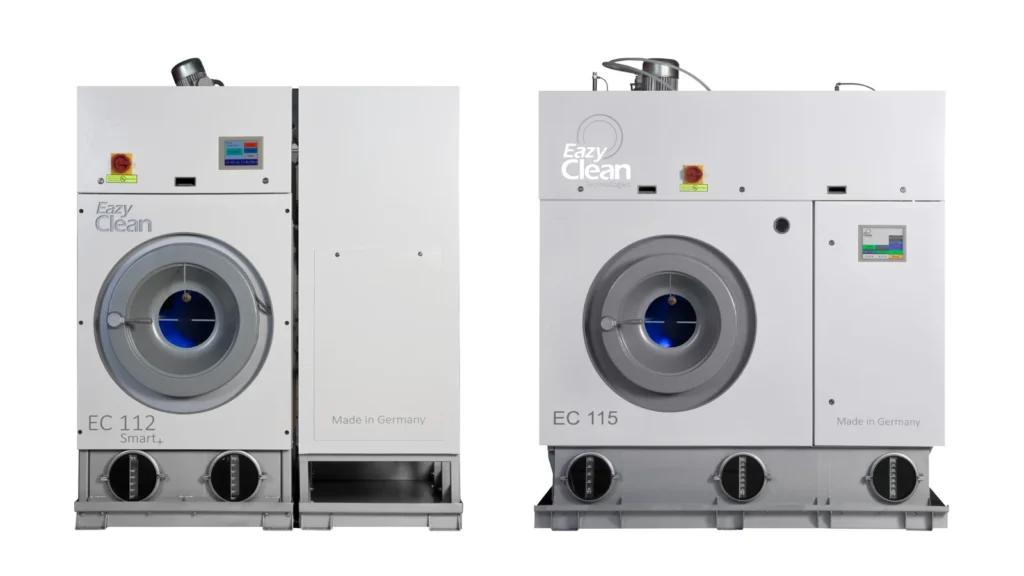
Both are entry prices. The final figure depends on drum size, equipment level and your connection situation — which is why most suppliers quote individually, and why a starting price is still worth publishing: it tells you in thirty seconds whether you are in the right conversation.
Prices valid at time of publication; binding only in a written quotation.
"Net ex works" is two statements, and both subtract things.
Net means excluding VAT and any other turnover tax. Where that tax is 19 or 20 per cent, the gap between net and gross is not a rounding error.
Ex works is the Incoterms delivery basis that puts the most on the buyer's side: the goods are made available at the seller's premises. As a rule it excludes loading, inland transport, export handling, freight, transport insurance, customs clearance, import duty and taxes, unloading at your site, moving the machine into position, connection, commissioning, operator training and the first solvent charge — unless a line in your quotation says otherwise.
We will not tell you what any of those cost: freight rates, duty rates and delivery times are not ours to promise and differ by destination, month and shipment. Get every one of them written down as a separate line before you compare two offers.
Why an ex-works price in euros is not the price at your door
The question reaches us from Dubai, from Nairobi, from across India. The euro figure above is the price at the factory gate in Herten, and between that gate and a working machine in your building sits a stack of costs nobody can quote generically:
Freight and insurance. Sea, air or road, by volume and weight, at the rate on the day you ship.
Customs and import taxes. The rate follows your tariff classification and your country. Ask your customs broker for the classification before you budget, not after the machine lands.
Inland transport and rigging. A solvent machine is heavy and does not go through a standard door. Measure door, corridor, floor loading and turning circle before you sign anything. Rigging a machine that does not fit is the most avoidable expensive surprise in this trade.
Site works. Floor, drainage, ventilation, the required extraction, fire compartmentation, and whatever your local permit demands.
Electrical supply — voltage and frequency. The one that gets missed. A machine configured for 400 V three-phase at 50 Hz is not simply plugged into a 60 Hz supply: motors and pumps driven at mains frequency turn faster, and drive, heating and protection sizing follow from that. Ask your supplier to confirm in writing that the machine is configured for your voltage, phase count and frequency, and that documentation and certification cover that configuration.
Commissioning and training on site. Who travels, who pays for the travel, how many days, in which language.
None of this makes an ex-works price dishonest. It makes it incomplete — which is why the answer to how much does a dry cleaning machine cost is always the machine price plus a landed-cost list you build yourself.
What you buy besides the machine
A dry cleaning machine on its own does not open a shop. A complete first fit-out also needs a finisher for shaping the garment, a spotting table for pre-treatment, and the required extraction — plus whatever your work demands beyond that, and the siting, connection, commissioning and training discussed above.
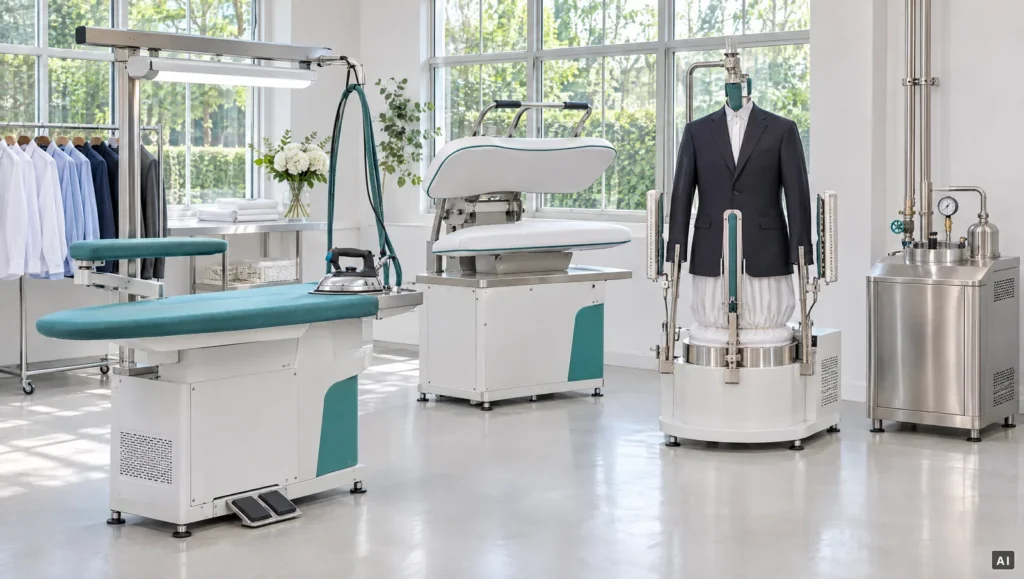
Nobody publishes a price list for this either, but individual pieces surface publicly. These are used or refurbished units from two public dealer inventories on 9 September 2026 — individual listings, not a price list:
| Item | Listed | Source |
|---|---|---|
| Shirt unit, 2019 | 25,000 USD | US dealer inventory |
| Boiler, 20 hp, 2015 | 15,000 USD | US dealer inventory |
| Double laundry topper, refurbished | 4,850 USD | US dealer inventory |
| Spotting board, refurbished | 1,550 USD | US dealer inventory |
| Steam finisher, light use | 4,000 GBP incl. VAT | UK dealer inventory |
Do not budget from that table; read it directionally. The total dry cleaning equipment cost for a first fit-out is not the machine plus a rounding error — finishing equipment is a second serious line, a boiler a third.
Running costs: take the formula, use your own numbers
Anyone who shows you a worked example of annual running costs is showing you their assumptions dressed up as your result. Here are the five formulas instead.
Solvent. Annual solvent spend = litres purchased per year x price per litre. Litres purchased is not what the machine circulates — it is what the machine loses, because a closed circuit returns the rest. This is where recovery rate decides the arithmetic: our machines recover 99.9 % of the solvent, so what leaves goes out with the still residue, the filters and the finished garments, not as a fresh charge every few loads. Compare suppliers on litres lost per cycle from their own documentation, at your drum load, times your cycles per year. A machine without high recovery does not cost a little more to run; it runs on a different equation.
Energy. Annual energy = kWh per cycle x cycles per day x operating days per year x your tariff. Insist on kWh per cycle at the load you will actually run; consumption quoted at the smallest programme is a marketing figure.
Filters. Annual filter cost = (cartridges per change x price per cartridge) x changes per year, where changes per year = annual cycles / cycles per cartridge. Ask for cycles per cartridge in writing.
Maintenance. Annual maintenance = service contract price, or expected service hours x hourly rate + parts. Ask for the recommended service interval and what a first-year parts kit contains.
Still residue disposal. Annual disposal = kg of residue per year x your local disposal rate per kg. Residue is what distillation pulls out of the solvent, so it scales with how dirty your intake is and how well the still works. The rate is set by your waste contractor and your jurisdiction, and nobody outside your country can quote it.
Two of those five — solvent and residue — move with recovery rate and distillation performance. That is the argument for paying more at purchase, and one to verify with your own volumes rather than take on trust. Across a service life of 20 to 30 years with regular maintenance, the running-cost column is the bigger number.
New vs. used dry cleaning equipment
Used and second hand dry cleaning equipment is a real market, with real bargains and real disasters in it, often on the same page.
We will not quote used prices, and neither should anyone else. They move constantly, they depend on age, hours, solvent history and who is selling, and a figure printed in an article is misleading within weeks. The public marketplaces we checked on 9 September 2026 carried machines of broadly similar description at prices an order of magnitude apart. That spread is not a market rate; it is the absence of one.
What decides whether a used machine is worth buying:
- The still. Distillation governs solvent consumption and residue volume. A tired still turns a cheap machine into an expensive one.
- Tanks, pumps, seals, the whole solvent circuit. Corrosion, weeping seals and pitted tanks are the repairs not worth doing.
- Drum bearings and spin. Expensive, and the failure that takes the machine out for weeks.
- The control. A discontinued controller with no spare parts sets a hard end date on the machine.
- Solvent history. A machine that ran perchloroethylene is not a hydrocarbon machine, and converting one is not a weekend job.
- Documentation. Data sheet, service history, certification, wiring diagrams. Without them every later fault becomes an investigation.
The risk of buying unchecked: on a marketplace you buy a photograph and a seller's description, and several listings we looked at came from accounts with no trading history. A machine from a dealer who inspects and refurbishes before sale costs more for a reason — somebody has opened it. Ours are inspected and refurbished before sale, and the stock changes constantly, so ask what is standing on the floor rather than reading a list.
How to compare two quotations
Most buyers ask two suppliers for a dry cleaning machine price and then find the offers cannot be compared. Insist on these lines and they can be.
The machine. Model designation. Drum capacity in kg — not litres, not pounds, unless converted alongside. Solvent type. Number of tanks. Spin speed. Machine dimensions, door dimensions and weight.
Process technology. Distillation: integrated or module, and capacity per hour. Filtration: type, cartridge count, cycles per cartridge. Solvent recovery rate as a percentage, in writing. Steel grade for all solvent-carrying parts.
Control. Controller type, number of programmes, measuring points monitored, whether the machine logs cycles, and how long spare control parts will be available.
Site requirements. Connected electrical load, supply voltage, phases and frequency. Water, steam and compressed air. Extraction. Floor loading.
Scope of supply. Delivery basis as an Incoterm — ex works, FCA, CIF and DAP are not the same offer. Then, line by line: transport, insurance, export documents, unloading, positioning, connection, commissioning, training days, initial solvent charge, spare parts kit, documentation and declaration of conformity.
Commercial terms. Currency. Net or gross. Validity. Payment terms. And explicitly: what is excluded.
If one supplier gives you all of that and the other gives you a number, you do not have two quotations. You have one quotation and one price tag.
Choosing among dry cleaning equipment suppliers
The field is smaller than it looks, and where a machine is built is worth a question. Ask every supplier where the machine is actually manufactured and where spare parts ship from. EazyClean Technologies builds in Herten, Germany.
Three questions separate a supplier from a reseller. Who commissions the machine at your site — the supplier's own people or a subcontractor? How are spare parts supplied to your country, and for how many years? Who answers the phone when the machine stops on a Friday afternoon?
A commercial dry cleaning machine for sale at an attractive number, from a supplier with no service presence in your market, is a twenty-year commitment to a stranger. The dry cleaning machine cost in the quotation is the smaller half of that decision.
The short version
How much does a dry cleaning machine cost? From roughly 65,000 EUR net ex works — ours are 65,770 EUR for the SMART Series and 83,990 EUR for the EC Series as of September 2026 — plus landed cost, plus finisher, spotting table and extraction, plus siting and commissioning, plus a running-cost column that outweighs all of it over twenty years. Anyone who answers with one number is answering a different question.
Tell us your daily kilograms, your garment mix and your supply voltage and frequency, and you get a configured quotation with those lines already in it.
FAQ
How much does a dry cleaning machine cost in 2026? A new commercial machine starts at roughly 65,000 EUR net ex works. Our SMART Series begins at 65,770 EUR and the EC Series at 83,990 EUR, both as of September 2026. The figure depends on drum size, equipment level and connection situation, and excludes freight, duty, siting and commissioning.
Is a used dry cleaning machine a good idea? It can be, if somebody has opened it. The still, the solvent circuit, the drum bearings and the availability of control spare parts decide the answer. We deliberately quote no used prices — they change constantly and vary by an order of magnitude between listings. Buy inspected and refurbished.
Can I buy a dry cleaning machine for home use? No. There is no household solvent machine, because solvent handling brings ventilation, fire-code and permitting duties a dwelling cannot meet. Home products are refresher kits from about 11 USD, garment steamers up to roughly 130 USD, and steam closets around 1,500 USD. None cleans in solvent.
What is the dry cleaning machine price for a small shop? Lower in absolute terms, higher per kilogram of capacity. A small machine needs the same control, still, pumps and safety chain as a large one, so a small dry cleaning machine price is never proportionally lower. Size on your realistic daily kilograms rather than on the budget.
How much does the rest of the dry cleaning equipment cost? A finisher, a spotting table and the required extraction are the minimum beside the machine, plus siting, connection, commissioning and training. Public dealer listings on 9 September 2026 showed refurbished finishing equipment from about 1,550 USD for a spotting board to 25,000 USD for a shirt unit.
Why do dry cleaning equipment suppliers not publish prices? Because configuration and connection situation genuinely change the figure, and because a quote form generates a lead. On 9 September 2026 we checked five dealer and marketplace sites in the US, Germany and Italy; they showed essentially no machine prices. Many suppliers answer with a quote form. We publish our starting prices.
Does high solvent recovery really lower running costs? It changes the equation rather than shaving it. In a closed circuit recovering 99.9 % of the solvent, purchases replace only what leaves with residue, filters and garments. Take litres lost per cycle from each supplier's documentation, multiply by your annual cycles and price per litre, and compare.
Sources
- EazyClean Technologies: Price list, September 2026, net ex works
- US Environmental Protection Agency: Dry cleaning facilities: national perchloroethylene air emission standards
- Target: Dryel At-Home Dry Cleaner Starter Kit
- LG: LG Styler S3WFBN steam closet
More articles
- How to Start a Dry Cleaning Business: Equipment & CostsNovember 16, 2026
- Hydrocarbon Dry Cleaning Machine or Perc? Solvent GuideNovember 16, 2026
- How Does a Dry Cleaning Machine Work? Inside the CycleNovember 16, 2026

