
Key takeaways
- Decide in a fixed order: route (new build or takeover), business model, solvent, machine size, site, then everything else.
- The solvent comes before the machine. It fixes your fire classification, ventilation design and permit path.
- The minimum equipment: a dry cleaning machine sized for one shift, spotting board, form finisher, utility press, steam boiler, compressor, extraction, solvent and waste storage, POS with item tracking.
- Machine entry prices at EazyClean Technologies: SMART Series from 65,770 EUR, EC Series from 83,990 EUR, net ex works, as of September 2026.
- Before buying a running shop, check its environmental history. Contamination can cost more than the purchase price.
This guide answers the questions you have to settle before you sign a lease: what equipment a dry cleaning plant needs, how much floor area and which utility connections it takes, which approvals apply, how to structure the capital, and how to decide between building new and buying a running shop. It is written by a machine manufacturer, so the equipment and connection sections of this guide on how to start a dry cleaning business go into more technical detail — and where we have no reliable number, you get the formula instead of an invented figure.
Two numbers for scale. IBISWorld counted 27,649 dry cleaning businesses in the United States in 2025, down 1.3 % on the year and falling about 1.1 % per year since 2020, in a market it sizes at 9.6 billion US dollars. Divide one by the other and the average business turns over roughly 347,000 dollars. That is arithmetic on two published figures, not a forecast for your shop, but it describes the situation: the number of plants is falling faster than the market as a whole.
How to open a dry cleaning business: the order of decisions
The decisions constrain each other in a fixed order, and taking them out of order is what costs money:
- Route — new build, or take over a running plant?
- Model — full plant with a shopfront, production plant with drop stores, or a drop store feeding someone else's plant?
- Solvent — this fixes your fire classification, ventilation design and permit path before you have chosen a machine.
- Machine size — drum capacity follows expected volume, not the other way round.
- Site — now you know the floor area, power, drainage and ventilation the site must provide.
- Everything else — finishing line, plant services, POS, fit-out.
Choosing the site first is the classic mistake. You find a good corner unit at a good rent, then discover it has single-phase power, a slab that will not take a loaded machine, and no route for an exhaust duct.
Dry cleaning business equipment: the full list
This is the dry cleaning business equipment for a plant that processes its own work. The right-hand column is the one people leave out of a budget — what happens if you skip the item.
| Equipment | What it does | If you leave it out |
|---|---|---|
| Dry cleaning machine | Cleans, extracts, dries and distils in one closed cycle | You have no business. This is the plant. |
| Form finisher (dolly) | Blows shirts, jackets, coats and dresses back into shape with steam and air | Everything goes on a press by hand. Throughput collapses, quality varies by operator. |
| Spotting board | Targeted stain removal before and after cleaning, with steam gun, vacuum and chemical guns | Stains survive the machine. Every stained item becomes a re-clean or a complaint. |
| Utility press (hot head) | Flat work, trousers, skirts, details the finisher cannot reach | Poor finish on exactly the garments customers inspect most closely. |
| Shirt unit, single or double buck | Body and sleeves of laundered shirts | Shirts become unprofitable. You drop them or lose money on them. |
| Trouser topper and legger | Waistband and seat, then legs with crease | Trousers take three to four times longer on a utility press. |
| Steam boiler | Feeds finisher, presses and spotting board | Nothing in the finishing room works. Not optional. |
| Air compressor with dryer and receiver | Drives press cylinders, clamps, finisher bags, machine valves | Presses will not close. Oil or water in the line stains garments. |
| Vacuum and suction | Pulls steam through the garment on boards and presses; extraction at the machine | Garments come off the board damp. Solvent vapour stays in the room. |
| Exhaust and room ventilation | Removes solvent vapour from machine area and finishing room | Usually a code requirement, not a preference. See the connections section. |
| Solvent storage and waste handling | Sealed drums for fresh solvent, still residue, spent filters | The fastest route to a failed inspection. |
| Conveyor, rail, sorting | Holds finished work in ticket order and returns it at the counter | Assembly becomes a search. Lost tickets and wrong garments start here. |
| Assembly and bagging station | Combines the pieces of an order, tags, bags | Orders go out incomplete. |
| POS and order management | Ticketing, item tracking, pricing, payment, routes | You cannot trace a garment, cost a job, or prove what you received. |
| Counter, racking, scales, carts | The unglamorous half of the fit-out | You buy it in week two anyway, at retail, in a hurry. |
The dry cleaning machine
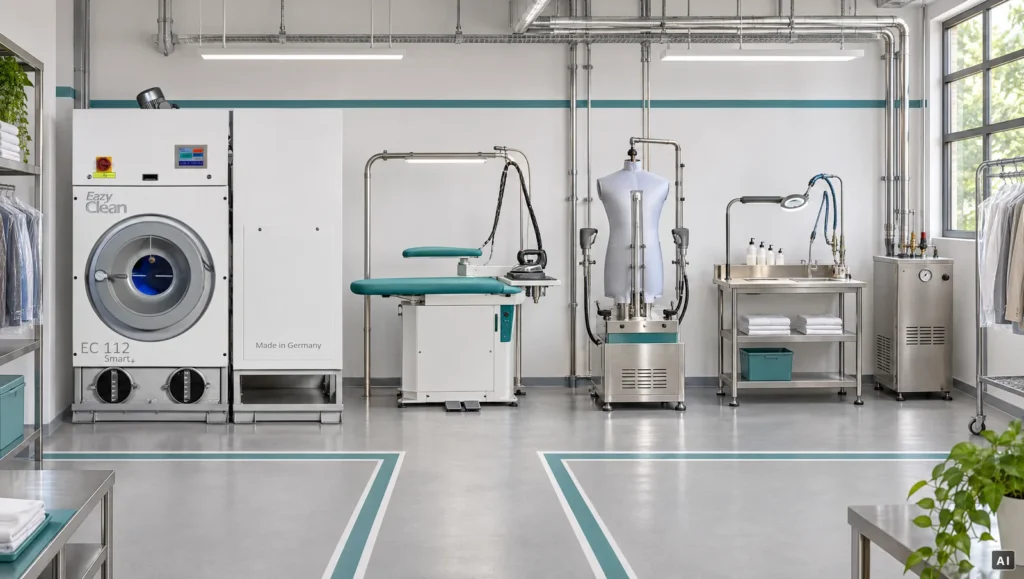
The machine defines the plant. Modern machines are dry-to-dry and fully closed: the load goes in dirty and comes out dry, and the solvent never leaves the circuit — it is condensed, distilled, filtered and returned. Recovery rate is the number to ask for, because it drives both your solvent bill and your emissions position. The machines EazyClean Technologies builds in Herten, Germany, run modern hydrocarbon solvent in a fully closed circuit at 99.9 % solvent recovery, with integrated distillation, filtration and solvent cooling.
Size by drum capacity in kilograms, and size by an ordinary working day rather than peak week. 30 integrated measuring points monitoring every cycle in real time is not a brochure feature: it is how you learn a cycle went wrong on the day it went wrong, instead of when the customer brings the garment back. The EC series runs up to 35 kg drum capacity and is built for multi-shift operation; the compact SMART series starts at 12 kg. Solvent-carrying components are austenitic stainless steel (V2A/V4A, equivalent to 304/316), and with regular maintenance the service life is 20 to 30 years.
That last figure matters more than it looks. A machine you keep for 25 years is not an annual cost, it is a fixed feature of the business — which is why the cheapest available drum is rarely the cheapest decision.
Equipment needed to start a dry cleaning business: the minimum that works
The honest floor for the equipment needed to start a dry cleaning business:
- Dry cleaning machine sized for one shift
- Spotting board
- Form finisher
- Utility press
- Steam boiler sized for the finishing equipment you own
- Air compressor with dryer
- Extraction and room ventilation to code
- Solvent and waste storage
- POS with item-level tracking
- Bagging station and a rail
Shirt unit, trouser topper, legger, conveyor and a second finisher are throughput decisions you add once you know your garment mix. Note what was not removed: ventilation, storage and the spotting board. Those are where people economise and where the consequence is regulatory or reputational rather than merely slow.
The shirt unit deserves a warning of its own. Shirts are the highest-volume, lowest-margin item in most shops, and without a shirt unit they eat operator time out of all proportion to what they earn. Decide deliberately whether you are in the shirt business. Do not drift into it.
List of dry cleaning equipment: the checklist to take to a dealer
Print this and price it line by line. Anything you cannot get a written quote for is not yet in your budget.
- [ ] Dry cleaning machine — drum kg, solvent type, recovery rate, connected load
- [ ] Delivery, rigging, installation, commissioning
- [ ] Form finisher · [ ] Utility press · [ ] Spotting board
- [ ] Shirt unit · [ ] Trouser topper · [ ] Legger
- [ ] Steam boiler, feed tank, water softener, blowdown
- [ ] Air compressor, dryer, receiver, distribution
- [ ] Vacuum system, extraction, ducting, discharge point
- [ ] Solvent store, waste drums, spill containment
- [ ] Conveyor or rail, sorting racks, carts, scales
- [ ] Assembly and bagging station, tagging, poly, hangers
- [ ] POS, printer, scanner, card terminal, customer display
- [ ] Counter, shelving, signage, lighting
- [ ] Fire extinguishers, detection, code-required safety items
- [ ] Spare parts kit and first service interval
Installation and commissioning
Owning the equipment is not the same as having it working. Set the maintenance schedule at handover. A machinery supplier's service lead, speaking to American Drycleaner, puts it plainly: go over all of it during installation — daily, weekly, monthly, semiannual, annual. He notes that modern machines carry far more electronics, and that simply keeping the machine clean matters more than operators expect, because power inverters with cooling fans overheat when left dirty. A finishing-equipment specialist quoted in the same series adds that newer finishing equipment is in some ways easier to maintain, since pneumatic systems no longer need constant oiling.
Measure from day one. That same specialist's advice is to track pieces per hour and the touch-up rate. Together they show the finishing line drifting out of adjustment before customers do — but only if the record starts at commissioning.
Site and floor area
Ask a site three questions in this order: can it take the equipment, can it take the utilities, can it take the customers.
Production area. Plan around the machine footprint plus the manufacturer's service clearance — technicians must reach the still, the filters and the button trap. Then the finishing line, usually the larger area, with operator space at each station. Then storage for incoming and finished work, which is always underestimated because it grows with the backlog, not the average.
Ceiling height. Form finishers and conveyors are tall, and steam and exhaust ducting runs overhead. A dropped structural beam through the production area will not take a conveyor, and retrofitting one means moving the finishing line.
Access. The machine arrives on a pallet and will not fit through a standard shop door. Confirm the route to the exact position — door width, corridor turns, thresholds, lift capacity above ground floor — before you sign anything. This is the most common late-stage surprise in a fit-out.
Retail versus production. Three models with different site requirements:
- Full plant with a counter. One rent, one team, walk-in trade — but it needs a location customers pass, the expensive kind, for a use that only needs the front three metres.
- Production plant plus drop stores. Plant somewhere cheap with good access, small drop stores where the customers are. This is how franchise systems scale, and it separates two contradictory location requirements.
- Drop store only. No machine, no permits, no plant services. Lowest capital, lowest margin, and your quality is somebody else's decision.
Connections: power, water, drainage, ventilation, floor load, fire
This is the section most guides skip, and it is where deals die.
Electrical supply. Machines and finishing equipment are three-phase — 400 V in Europe, commonly 208–240 V or 480 V in North America. The supply must carry machine, boiler, compressor and finishing line simultaneously, not one at a time. Collect the connected load in kW from every spec sheet before you talk to the landlord, and have an electrician confirm capacity at the panel and the cost of an upgrade. In older retail units, "there is power" often means single-phase.
For scale: a dealer spec sheet for a double buck shirt press alone lists 3-phase 220 V at 12 A, 105 kg of steam per hour at 110 psi, and compressed air at 85 psi. That is one machine in the finishing line, and it already dictates a boiler size and a compressor size.
Water and drainage. Softened fresh water for the boiler, because scale destroys boilers. On the drain side, separated contact water from the machine's water separator is regulated waste in most jurisdictions and does not go to sewer untreated. Ask the sewer authority in writing.
Ventilation and exhaust. The International Fire Code, Chapter 21, gives numbers you can design against. Dry cleaning and drying rooms require mechanical ventilation exhausting 1 cubic foot per minute for each square foot of floor area, running automatically whenever the equipment runs. Type IV and V systems require an exhaust maintaining not less than 100 feet per minute through the loading door when it is open. Spotting, scrubbing and brushing stations must sit where their vapours are captured. Where flammable vapours are possible, the code requires automatic detection and shutdown at 25 % of the lower flammable limit in the exhaust duct.
Floor load. A loaded machine plus its solvent charge is a concentrated point load. Slab on grade is straightforward; anything above grade or over a basement needs a structural check. Vibration into a residential floor above is a separate and expensive problem.
Fire classification. Under IFC Chapter 21 and NFPA 32, solvents are classed by flash point: Class I below 100 °F (38 °C), Class II from 100 to under 140 °F, Class IIIA from 140 to under 200 °F (60–93 °C), Class IIIB at or above 200 °F, Class IV for solvents classified as nonflammable. Plant type follows the solvent — Type I plants are prohibited, Type III-A run Class IIIA, Type IV and V run Class IV — and where several classes are present, NFPA 32 classifies the facility by the lowest-numbered class. This drives sprinklers: Type III-A plants are exempt only where aggregate Class IIIA solvent in machines and storage stays at or below 330 gallons and machines carry specified safety features. Quantity limits also apply at workstations, such as one gallon at a spotting table.
Take your solvent decision to the fire officer early. The classification is not negotiable after the fit-out.
Permits and approvals
Specifics are jurisdictional and they change. What follows is the shape of the problem, not legal advice — confirm every item with the authority named.
United States. Federal air rules for perc dry cleaning sit in the NESHAP for perchloroethylene dry cleaning facilities (40 CFR Part 63 Subpart M), with EPA's TSCA risk management rule now overlaying a phase-out. State and local air districts add their own permits, and several states run dedicated dry cleaner environmental programmes with registration, fees and remediation funds. Fire approval comes from the local fire authority under IFC Chapter 21; workplace exposure and ventilation fall under OSHA. Your state's Small Business Environmental Assistance Program exists for exactly this and is the cheapest place to start.
Europe and Germany. Solvent installations are regulated through national implementations of the EU industrial- and solvent-emissions framework. In Germany, dry cleaning installations fall under the Bundes-Immissionsschutzgesetz and its ordinances: the 2. BImSchV, in force since 1990, requires closed or semi-closed machines and operation in the presence of qualified personnel, and solvent emission limits sit in the 31. BImSchV. Workplace protection runs through the Gefahrstoffverordnung and the relevant TRGS. On the trade side, Textilreiniger has been a zulassungsfreies Handwerk since the 2004 Handwerksordnung reform: you register the trade and enter the Handwerksrolle, and a Meisterbrief is not a legal precondition. The Deutscher Textilreinigungs-Verband, with roughly 800 member businesses, runs the Meister course for those who want the qualification anyway.
Everywhere. Recurring inspections are a permanent operating cost, not a one-off: pressure equipment, electrical installation, ventilation performance, solvent handling records. Budget the time as well as the fee.
Choosing a solvent
A founding decision, not an operating one, because it sets your fire classification, ventilation design, permit path and the resale value of your machine.
Perchloroethylene is in retreat. EPA's December 2024 risk management rule under TSCA sets a staged phase-out of perc in dry cleaning: as published, use in newly acquired machines ends within months of the rule taking effect, third-generation machines come out of service in December 2027, and all remaining perc dry cleaning ends in December 2034. Europe has moved the same direction for longer, through progressively tighter installation and emission requirements. Rules get amended and litigated — confirm the current text with EPA and your state agency, or your Immissionsschutzbehörde in Germany, before you plan a date around it.
Modern hydrocarbon solvent is widely used in new installations. It does not carry perc's regulatory trajectory, and in a closed machine with high recovery the consumption is small. Its trade-off is the flash point: a Class IIIA combustible liquid, which puts you in a Type III-A plant with the fire-code consequences above. There is a separate article comparing the two on garment care, machine design, regulation and running cost. Read it before you order, not after the machine arrives.
How much does a dry cleaning business cost?
Build the number from your own quotes. This is the structure to fill in:
| Block | What is in it |
|---|---|
| Dry cleaning machine | Machine, delivery, rigging, installation, commissioning |
| Finishing line | Finisher, presses, spotting board, shirt unit if applicable |
| Plant services | Boiler, compressor, vacuum, extraction, ducting, water treatment |
| Fit-out | Electrical upgrade, drainage, floor, ventilation routing, counter, racking, signage |
| Deposits and lease | Security deposit, first rent, landlord contribution to works |
| Permits and professional fees | Applications, fire, structural check, environmental assessment, legal |
| Working capital | Solvent, chemicals, hangers, poly, tags, spares |
| Ramp-in loss | Wages, rent and utilities while volume builds to break-even |
The last line is the one founders leave out and the one that closes shops.
Two anchors you can check. For the machine, EazyClean Technologies publishes entry prices: the SMART series from 65,770 EUR and the EC series from 83,990 EUR, net ex works, as of 9 September 2026. Final price depends on drum size, specification and the connection situation on site. What else belongs in the quotation is set out in how much a dry cleaning machine costs.
For a whole plant, the most solid public figure in the industry is a franchise disclosure document, because it is filed rather than estimated. One US franchise system's 2025 FDD, Item 7 puts a plant facility at roughly 762,000 to 1,198,000 US dollars all-in, with production equipment and installation at 325,000–425,000 USD, leasehold improvements at 195,000–290,000 USD, six months of additional operating funds at 100,000–200,000 USD, POS and technical equipment at 16,000–25,000 USD, and initial production supplies at 24,000–30,000 USD. That is one US franchise's high-volume model with fees and brand standards attached, not a target for an independent — but it shows the proportions, and it shows equipment is roughly a third of the build, not the whole of it.
You will find figures elsewhere claiming a dry cleaning business costs "50,000 to 150,000 dollars" or "30,000 to over a million". Those ranges do not state their sample and span two orders of magnitude, so they are of limited use for planning. Use quotes. Then price the alternative — the section on buying a running plant sets the two side by side.
Dry cleaning business profit: how to model it
There is no honest single answer to how profitable a dry cleaning business is, because local price level, rent and labour cost vary more between two towns than between two industries. Model it rather than look it up.
Revenue.
“ Daily revenue = pieces per day × average price per piece “
Pieces per day is not machine capacity. It is the lowest of: machine cycles per day × kg per cycle ÷ average kg per piece; finishing output per hour × productive hours; and demand. In a new shop, demand binds for the first year and finishing capacity after that. Almost never the cleaning machine.
Cost. Track four buckets, because they behave differently:
- Labour — largely fixed once staffed, and the largest controllable block
- Occupancy — rent, rates, insurance: fixed
- Energy — semi-fixed, since a boiler at temperature costs money whether garments move or not
- Consumables — solvent, detergent, hangers, poly, tags: genuinely variable per piece
“ Break-even pieces per day = fixed costs per day ÷ (price per piece − variable cost per piece) “
Run that before you sign the lease. If break-even needs more pieces per day than the finishing line can produce, the plan is wrong however good the location is.
In a closed machine with high recovery, solvent is a small line; energy is not, because boiler and finishing line run whether or not the machine is loaded. That is why utilisation matters more than any single efficiency figure. If you want a payback period, calculate it from your own quotes and your own tariff. Any payback figure printed in an article was written without knowing either.
New versus used dry cleaning equipment for sale
Searches for used dry cleaning equipment for sale run at roughly the same volume as searches for how to start a dry cleaning business, which tells you how many founders arrive at the same idea. It is a legitimate route, with conditions.
Where used works well. Presses, spotting boards, racking, conveyors, carts and counters are mechanically simple, wear predictably and are cheap to inspect. Buying these used is often right, and it frees budget for the machine.
Where used needs care. The cleaning machine and the boiler. Ask for age, running hours, service records, and specifically what was replaced during refurbishment — a machine that has been cleaned up is not a machine that has been overhauled. Have a technician you chose inspect it before payment. Confirm generation and solvent history, because the perc phase-out has made older perc machines hard to resell in the US and the solvent history affects what you can legally run.
Understand the difference between used and refurbished. Private used equipment is generally sold as is, with no recourse. Dealer-refurbished equipment is inspected, repaired and tested and normally carries a limited warranty, which is typically short – ask for the exact term in writing. EazyClean Technologies sells used machines that are tested and refurbished before sale; available stock changes continuously, so ask rather than watch a page.
When new is right. When the machine is the constraint on the whole plant — which it is, because everything else is scheduled around it. On a 20-to-30-year asset the new/used difference is a smaller share of lifetime cost than it appears on day one, and a new machine comes with current recovery performance, current controls, and a maintenance history that starts with you rather than a stranger.
Buying a dry cleaning business for sale
More people search for a dry cleaning business for sale than search for how to start a dry cleaning business from scratch. In a consolidating industry with 27,649 US businesses and a count falling about 1.1 % a year, that is rational: you buy revenue on day one instead of building it over two years, and retiring owners are in steady supply. Done badly, it is also the fastest way to lose more money than a new build would have cost.
What the market actually asks
Real listings are the best public evidence available, because a seller has committed to a number. Retrieved from BizBuySell on 9 September 2026, the market summaries read as follows. These are medians of businesses currently advertised, not industry averages, and asking prices are asks, not transaction prices:
| Market | Median asking price | Median reported revenue | Median owner earnings |
|---|---|---|---|
| United States, all listings | 258,888 USD | 306,686 USD | 120,000 USD |
| Texas | 457,500 USD | 605,000 USD | 143,500 USD |
| New York | 299,999 USD | 340,000 USD | 136,320 USD |
| Washington | 270,000 USD | 350,000 USD | 160,000 USD |
| California | 240,000 USD | 310,000 USD | 120,000 USD |
| New Jersey | 200,000 USD | 246,983 USD | 100,000 USD |
Three things fall out of that table.
The multiple. Median ask divided by median owner earnings is roughly 2.2 nationally — consistent with the 1.5× to 3.0× SDE range business valuation firms publish for the sector. If a seller wants four times earnings, they are asking you to pay for something the market does not normally pay for. Make them name it.
The spread. Texas asks more than twice New Jersey for the same kind of business. Price follows local revenue and local rent, not the industry. Any national number, this one included, is a sanity check and not a valuation.
The comparison that matters. A US franchise plant build runs 762,000 to 1,198,000 dollars on that franchise system's 2025 FDD. The median listed dry cleaner asks 258,888 dollars — with customers attached. That gap is not free money. It is the price of the risks below.
Environmental history: the risk that can exceed the purchase price
Start here, before the books. Perchloroethylene migrates into soil and groundwater, and liability attaches to the property, so an owner can be responsible for contamination they did not cause and did not know about.
Commission a Phase I Environmental Site Assessment: a records, historical-use and site review identifying Recognized Environmental Conditions without invasive sampling. If a REC appears, the All Appropriate Inquiries process points to a Phase II with actual sampling — on a dry cleaner, typically cored through the floor beside current and former machine pads, and sampled at the back door, present and past dumpster locations, and along the sanitary sewer corridor, because that is where decades of small losses went.
Two things founders get wrong. A shop running hydrocarbon today may have run perc for thirty years before that, and the soil remembers the thirty years — ask what was in the machine in 1995. And finding contamination does not end a deal: it changes the price, the structure, the indemnities, and whether you buy assets or the entity. Not looking is what ends deals badly, often years later when a lender or the next buyer commissions the assessment you skipped.
Machine age and remaining service life
Ask for generation, year of manufacture, running hours, solvent history and service records — then price the replacement in, because on a 20-to-30-year asset you are buying what remains. In the United States this now has a date attached: a plant running a perc machine is a plant with scheduled capital expenditure, and the price should reflect that a new machine is coming. A seller describing a perc machine as "recently serviced" is answering a different question.
Lease, customers, staff
The lease. Remaining term, renewal options, rent review mechanism, permitted use, and whether the landlord will consent to ventilation routing and structural work. A plant is not portable: relocating means new fit-out, new permits, and losing the walk-in customers who chose you for being on their route. A short remaining term on a business you cannot cheaply move is the weakest negotiating position available — and it is why a cheap listing is sometimes cheap.
The customers. Split revenue into walk-in retail, contracted commercial and wholesale. Wholesale concentrated in one or two accounts is a risk, not an asset, unless the contracts are written and transfer. Ask for the tail as well as the total: how many customers, how often, and how much of last year's revenue came from customers who have ordered again this year. A book that is one hotel and two restaurants can halve with one phone call.
The staff. In a shop running on one experienced presser and one spotter, the business walks out with those two people. Establish whether they intend to stay, what they are paid, and whether the seller has been subsidising the wage bill by pressing themselves — an owner-operator's unpaid labour sits inside the reported owner earnings, and replacing it with a hired presser comes straight off the number you are buying.
Then ask why they are selling, and verify the answer against the revenue trend. Retirement and a five-year decline are two different businesses at the same asking price.
Staff and training
Two skills take real time to acquire: spotting and finishing. Machine operation is learned in days; stain chemistry and a consistent press are not.
The Drycleaning & Laundry Institute has run its School of Drycleaning Technology since 1927, with a one-week hands-on introduction and a two-week advanced course covering sorting, fabric construction, soil and cleaning theory, machine operation and stain-removal chemistry, plus member on-site training. In Germany the Deutscher Textilreinigungs-Verband runs the Meister course. Machine suppliers train operators on the specific installation, which is necessary but replaces neither.
Plan the shift pattern before you size the machine. A 35 kg machine in a single-shift shop is an expensive way to own idle capacity; the same machine across two shifts is a different business.
The most common mistakes
- Signing the lease before checking three-phase capacity, drainage, exhaust route and delivery route. In that order.
- Buying the machine last. It sets every other requirement — ask your supplier early what the procurement timeline actually is, and plan the fit-out around it.
- Sizing to peak demand. You pay for the peak all year.
- Under-building the finishing line. The cleaning machine is rarely the bottleneck. The press is.
- Treating extraction and ventilation as optional. They are code, they are inspected, and retrofitting ducting through a finished shop costs multiples of installing it during fit-out.
- No ramp-in capital. Volume takes months. Rent and wages do not wait.
- Deciding the solvent after the fit-out. It determines the fire classification, which determines the fit-out.
- Skipping the Phase I ESA when buying. The cheapest possible way to inherit a six-figure liability.
- No item-level tracking. Every lost-garment dispute you cannot resolve is a customer and a refund.
- Competing on price with a machine that cannot support it. Volume you cannot finish is not revenue, it is a backlog.
Every one of these gets harder and more expensive the later you take it. Work in the order at the top of this article, and get the machine and the site to agree with each other before anything is signed.
Machine prices are those published by EazyClean Technologies as of 9 September 2026, net ex works. Regulatory references are to sources as published on the dates given and are not legal advice — confirm current requirements with the competent authority for your site.
FAQ
How do I start a dry cleaning business from scratch? Decide route and model first, then solvent, then machine size, then site — because the machine determines the power, drainage, ventilation and floor load the site must provide. Only then plan fit-out, permits and finishing line. Reversing that order is what produces expensive surprises during fit-out.
What equipment is needed to start a dry cleaning business? At minimum: a dry cleaning machine, spotting board, form finisher, utility press, steam boiler, air compressor with dryer, extraction and room ventilation, solvent and waste storage, a POS with item-level tracking, and a bagging station. Shirt unit, trouser topper, legger and conveyor are throughput decisions you add once you know your garment mix.
How much does a dry cleaning business cost to open? Build it from quotes in eight blocks: machine, finishing line, plant services, fit-out, deposits, permits and fees, working capital, and ramp-in loss. As one filed reference point, one US franchise system's 2025 FDD puts a US franchise plant at roughly 762,000–1,198,000 dollars, with production equipment at 325,000–425,000 dollars.
How profitable is a dry cleaning business? It depends on local prices, rent and labour cost more than on the industry. Model it: daily revenue equals pieces per day times average price, and break-even pieces per day equals fixed costs per day divided by contribution per piece. Published margin ranges of "5 to 20 percent" span too wide a band to plan against.
Do I need a licence or a master craftsman qualification? In Germany, Textilreiniger has been a zulassungsfreies Handwerk since the 2004 reform — register the trade, enter the Handwerksrolle, no Meisterbrief legally required. Elsewhere requirements differ. Environmental, fire and workplace approvals apply everywhere; confirm each with the competent authority for your site.
Which solvent should a new plant use? Modern hydrocarbon solvent is widely used in new installations. Perchloroethylene is under a staged phase-out in the United States under EPA's 2024 TSCA rule and under tightening requirements in Europe. Hydrocarbon is a Class IIIA combustible liquid, which sets your fire classification and ventilation design — settle it before the fit-out.
How much space and what power supply does a dry cleaning plant need? Plan around the machine footprint plus the manufacturer's service clearance, then the finishing line, then storage, which is always underestimated. Supply is three-phase — 400 V in Europe, 208–480 V in North America — sized for machine, boiler, compressor and finishing line running simultaneously, not one at a time.
Is used dry cleaning equipment a good idea? For presses, spotting boards, racking and conveyors, usually yes. For the cleaning machine and boiler, only with running hours, service records, a stated refurbishment scope and an inspection by your own technician. Used as-is and dealer-refurbished with a limited warranty are not the same purchase.
What does a dry cleaning business sell for? On BizBuySell listings retrieved 9 September 2026, the median asking price for a US dry cleaner was 258,888 dollars against median reported revenue of 306,686 dollars and median owner earnings of 120,000 dollars — roughly 2.2 times earnings. Those are asks on advertised listings, not closed transactions, and they vary widely by state.
What should I check before buying a dry cleaning business for sale? Commission a Phase I Environmental Site Assessment first: perc contamination can outweigh the purchase price, and liability follows the property. Then machine generation, age and remaining service life; lease term and permitted use; the split between walk-in and contracted commercial revenue; and whether the skilled staff transfer.
Sources
- IBISWorld: Dry cleaners in the US: number of businesses
- IBISWorld: Dry cleaners in the US: market size
- US Environmental Protection Agency: Risk management for perchloroethylene (PCE)
- Federal Register: National emission standards for hazardous air pollutants: perchloroethylene dry cleaning (2025)
- EnviroForensics: EPA finalizes rules to ban TCE and phase out PCE
- EnviroForensics: Why Phase I environmental site assessments matter when buying or selling a dry cleaner
- UpCodes: New York Fire Code 2020, chapter 21: Dry cleaning
- NFPA: NFPA 32, Standard for Drycleaning Facilities (PDF)
- Drycleaning & Laundry Institute: School of Drycleaning Technology
- BizBuySell: Dry cleaners for sale
- Peak Business Valuation: Valuation multiples for dry cleaning
- Deutscher Textilreinigungs-Verband: Meisterkurs (German)
- gewerbeanmeldung.de: Textilreinigung anmelden (German)
More articles
- How Much Does a Dry Cleaning Machine Cost? 2026 PricesNovember 16, 2026
- Hydrocarbon Dry Cleaning Machine or Perc? Solvent GuideNovember 16, 2026
- How Does a Dry Cleaning Machine Work? Inside the CycleNovember 16, 2026

