
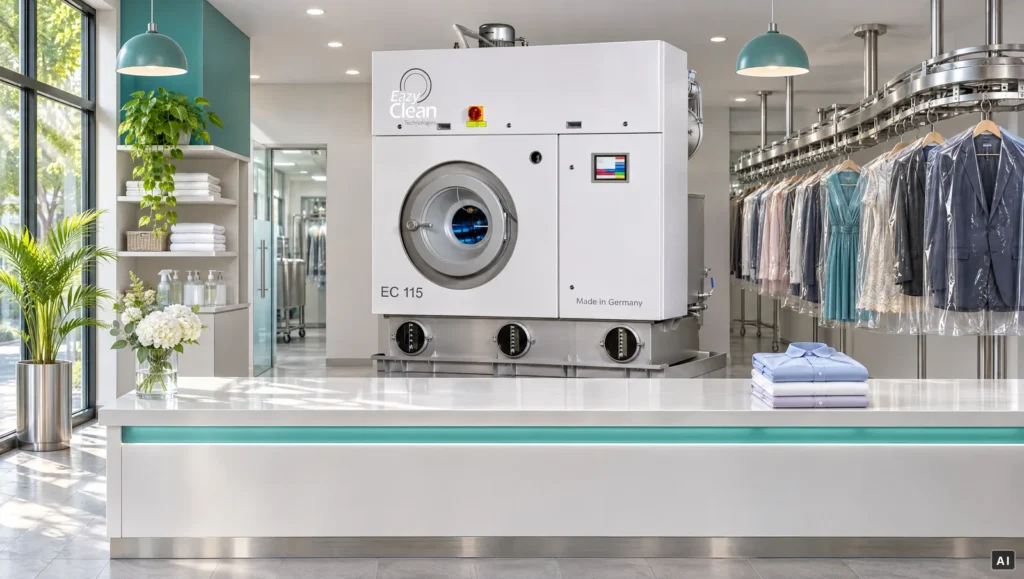
Key takeaways
- Dry cleaning washes garments in a liquid solvent instead of water. The drum is filled about one third, and the solvent dissolves oils and grease without swelling the fibres.
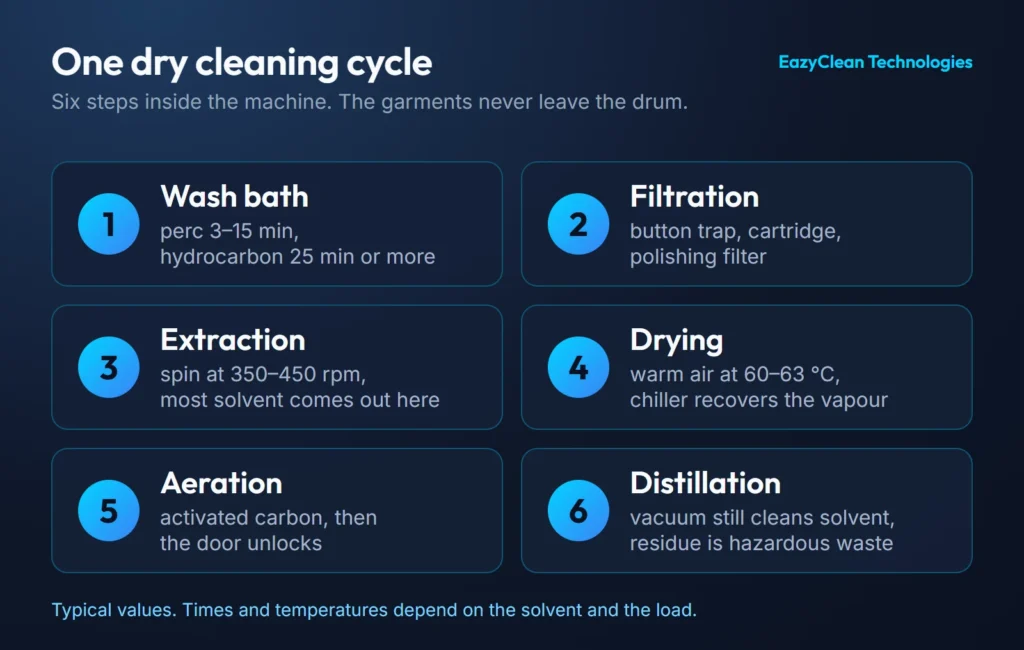
- A modern machine washes, filters, spins at 350–450 rpm, dries with warm air of about 60–63 °C and distils the solvent in one sealed unit. The garments never leave the drum.
- In a closed-loop machine the drying air is chilled, the solvent vapour condenses and is reused. In normal operation no drying air is vented outdoors.
- The machine cycle takes about 45 to 60 minutes with hydrocarbon solvent. The usual two to three day turnaround is queueing, spotting and pressing.
- Perchloroethylene is increasingly restricted. EazyClean Technologies machines run modern hydrocarbon solvent and recover 99.9 % of it.
Dry cleaning works by washing garments in a liquid chemical solvent instead of water. The clothes turn in a perforated drum, the drum fills roughly one third of the way with solvent, the solvent dissolves oils and greasy soil, and it is then spun out, filtered, distilled and pumped back in to be used again. If you want the one-paragraph answer to how does dry cleaning work, that is it: the same mechanical action as a washing machine, a different liquid, and a recovery loop that a washing machine has no need for.
The longer answer is where the useful parts are: why the solvent is chilled, what the still at the back of the machine does, why a hydrocarbon wash runs several times longer than the perc wash it replaced, and why the letter in the circle on your care label is a statement about chemistry.
We build the machines, so this is written from that side of the counter.
Why Is It Called Dry Cleaning?
Because there is no water in it. Water swells cotton and wool fibres, lets dyes migrate and lets knits relax and shrink. Solvent does none of that: it wets the surface, dissolves the oily binder holding soil to the fibre, and evaporates without changing the fibre’s dimensions.
The load is soaking wet in the drum and bone dry at the end, and no water was ever involved. The name describes the fabric’s experience, not the machine’s.
The trade dates itself to Jean Baptiste Jolly, a Paris dye-works operator who opened a cleaning service in 1845 using petroleum distillates — kerosene and gasoline, in practice. The industry then spent a century looking for something that cleaned as well without burning the shop down.
What Is Dry Cleaning Solvent?
Not one chemical but several, and they behave measurably differently. What separates them is the Kauri-butanol value, a lab measure of how aggressively a solvent dissolves heavy grease: higher KB means faster on oil, harsher on dyes, coatings and adhesives.
| Solvent | KB value | Notes |
|---|---|---|
| Perchloroethylene (perc, PCE) | 90 | Non-flammable, boils at 121 °C, dominant since the 1950s, increasingly restricted |
| Hydrocarbon (high-flashpoint petroleum) | 27-45 | Flash point above 60 °C in modern grades, gentler on dyes and trims, needs longer cycles |
| Siloxane D5 (marketed as GreenEarth) | 13 | Very low surface tension, very mild, weakest on heavy grease |
| Dibutoxymethane (SolvonK4) | — | Bipolar: attacks both oil- and water-based soil |
| Liquid CO2 | — | Very gentle, costly equipment, weaker on ground-in grime |
Surface tension matters as much as KB value. Water sits at about 72 dyn/cm; perc is around 32, hydrocarbon around 24, siloxane around 17. That is why solvent flows into a tailored shoulder, through a beaded appliqué and around a fused interlining without forcing the fibres apart — and why it leaves no water rings.
The trade-off is real: a low-KB solvent is kinder to the garment and slower on the stain. Manufacturers close that gap with cycle design and detergent chemistry.
How Does Dry Cleaning Work Inside the Machine?
A modern machine is a single sealed vessel that washes, extracts, dries and reclaims; the garments never leave the drum between steps.
1. The wash bath
The drum fills to roughly one third with solvent and turns. A small dose of dry cleaning detergent goes in with it, dosed automatically on current machines rather than by eye. It does something water-based detergent cannot: it carries a trace of moisture into the solvent, so water-soluble soil, sugars and salts have something to dissolve into.
Wash length depends on the solvent. A perc cycle runs 3 to 15 minutes; hydrocarbon needs at least 25, because the lower KB value means oily soil dissolves more slowly. Anyone comparing two cleaners on turnaround alone is partly comparing their chemistry.
Solvent circulates the whole time — roughly 8 litres per kilogram of load per minute — so the bath is being cleaned while it cleans.
2. Filtration during the wash
Three stages, in order:
- Button trap. Catches lint, coins, pens and the buttons that did not survive.
- Cartridge filter. Activated clay and charcoal pull fine soil and loose dye out of the stream — this is what stops white shirts going grey next to a navy jacket.
- Polishing filter. A final pass for anything the cartridge let through.
Customers never see this step. It decides whether garment number 400 comes out as clean as garment number one.
3. Extraction
The drum accelerates to 350-450 rpm and spins the free solvent out, exactly like a washing machine’s spin. A well-maintained machine recovers well over 90 % of the bath here alone, before any drying. That solvent goes to the still.
4. Drying, and why the solvent is chilled
Warm air, typically 60-63 °C (140-145 °F), circulates through the load and evaporates the solvent still held in the fibres. Hydrocarbon machines run this stage more conservatively, well below the solvent’s flash point, and take longer over it.
That air then passes over a refrigerated condenser. The machine heats the air and immediately spends more energy chilling it, which sounds wasteful until you see why: solvent vapour is only recoverable as a liquid. Below the dew point it condenses on the coil, runs off and is collected. Skip the chiller and that solvent leaves through the vent — money out of the roof, and a regulated release.
In a closed-loop machine the chilled air is then reheated and sent round again. In normal operation, no drying air is vented outdoors.
5. Deodorising and aeration
Cool air circulates over the garments and through a vapour-recovery filter of activated carbon and polymer resin, stripping the last traces of solvent. This is the step that decides whether clothes come back smelling of the shop.
Fifth-generation machines add a sensor and a door interlock: the drum will not open until the internal concentration has fallen below 300 ppm. If a garment has ever come back with a chemical smell, the machine was most likely older than that or overdue for service.
6. Distillation
The dirty solvent from extraction and condensation goes into a vacuum still built into the machine. Coils heat it until the solvent boils; the vapour rises to a condenser and returns as clear liquid. Everything that will not boil at that temperature — soil, body oils, dye, spent detergent — stays behind as residue and is disposed of as hazardous waste.
The vacuum is not decoration: distilling at reduced pressure lowers the boiling point, which means less heat, less thermal stress on the solvent and no residue cooked onto the coils.
Distillation is the reason dry cleaning is not simply expensive per litre. The fluid is not consumed. It is used, dirtied, boiled clean and used again.
Closed Loop Versus Open Loop
The single largest change in the industry in forty years, and it is invisible to customers.
| Open loop (vented) | Closed loop | |
|---|---|---|
| Drying air | Exhausted outdoors | Recirculated internally |
| Solvent in that air | Lost | Condensed and reclaimed |
| Shop atmosphere | Detectable solvent odour | Effectively none in normal operation |
| Consumption | Continuous top-up | Top-up for residue and carry-off only |
First- and second-generation machines vented. The third added a refrigerated condenser, the fourth a carbon adsorber behind it, the fifth the concentration sensor and door interlock.
The question of how does dry cleaning work therefore has a different answer in 2026 than it had in 1985, and the difference is not in the wash — it is in what happens to the fluid afterwards.
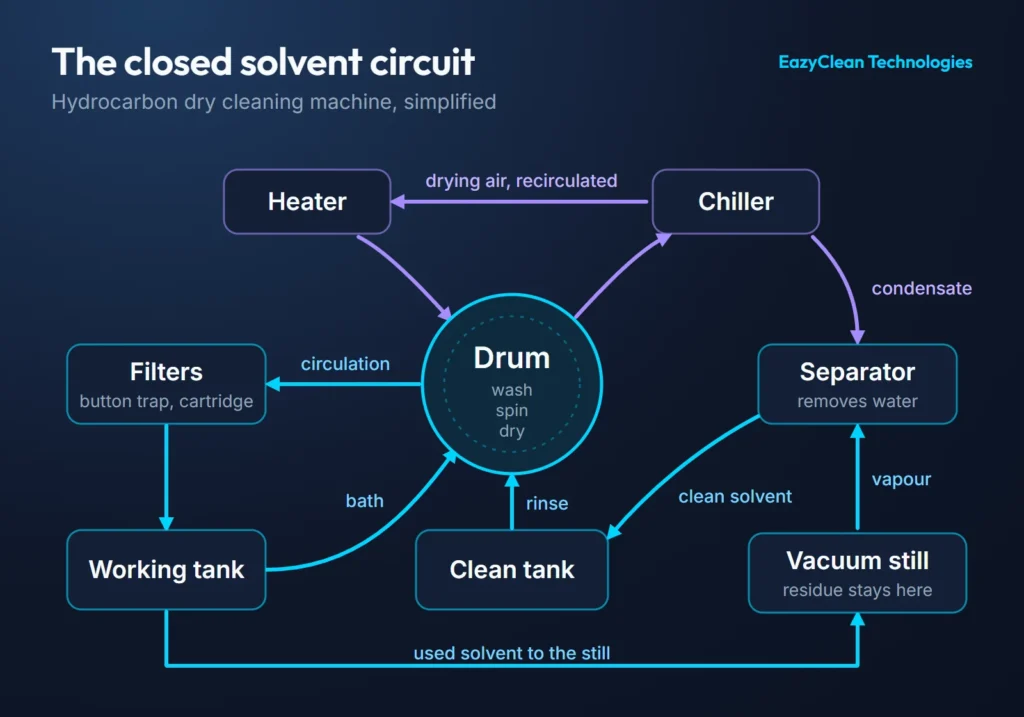
Our own machines at EazyClean Technologies run modern hydrocarbon solvent in a fully closed circuit with integrated distillation, filtration and solvent cooling, and reclaim 99.9 % of it. Thirty measuring points monitor each cycle in real time, which is what lets the machine decide when drying is finished based on measured values. Every solvent-carrying component is austenitic stainless steel (V2A/V4A, equivalent to 304/316) — because corrosion in a solvent circuit is a leak risk.
What the Shop Does Around the Machine
The machine is maybe half the outcome. The rest is people.
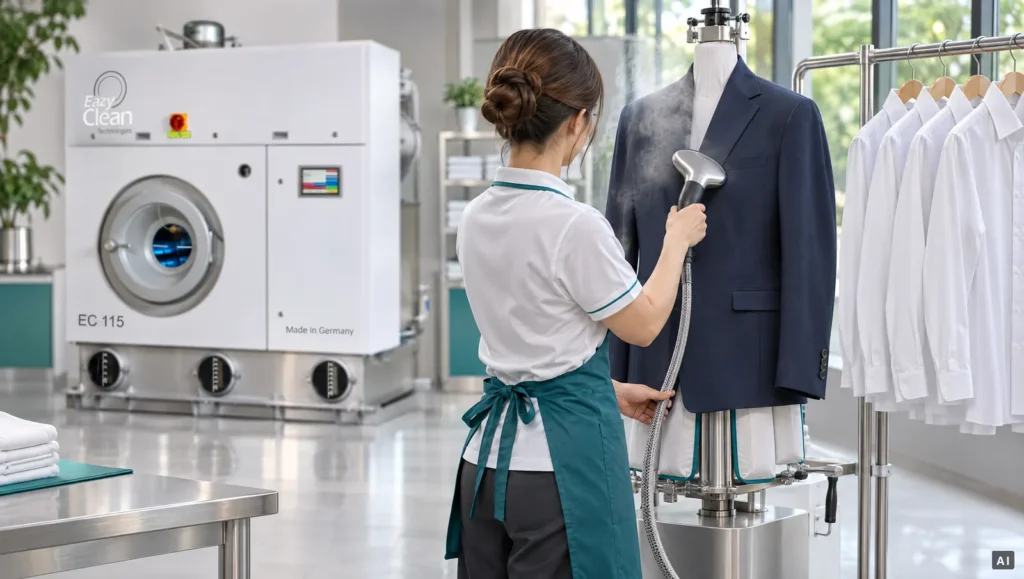
- Inspection and tagging. Every item is checked for damage, loose trim and existing stains, then tagged.
- Pre-spotting. A spotter works the stain at a spotting board with steam, vacuum and a chosen chemical class before the garment goes near the drum. This step removes the stain; the machine removes the soil.
- The cycle. As above.
- Post-spotting. Anything the cycle did not lift gets a second, targeted attempt.
- Finishing. Steam-and-form pressing on a finisher restores the shape that cleaning relaxed. A jacket that comes back looking new looks that way because of this step, not the wash.
The real skill sits in steps 2, 4 and 5. Two shops running the same machine and the same solvent will not deliver the same result.
How Long Does Dry Cleaning Take?
The machine cycle runs roughly 45 to 60 minutes end to end for hydrocarbon: wash, extract, dry, deodorise. Your garment is not in the machine for two days — the turnaround you are quoted is queueing, spotting, pressing and inspection.
| Item | Typical turnaround |
|---|---|
| Shirts, blouses, trousers | 1-2 business days |
| Suits | 2-3 business days |
| Beading, sequins, embellishment | 3-4 business days |
| Leather, suede, fur | 5-7 business days, often sent to a specialist |
| Express service | Same day to 24 hours, at a premium |
Two to three business days is the standard. Express is real, not a trick — but it means your garment jumps the queue, not that the wash runs faster.
Does Dry Cleaning Actually Clean Clothes?
Yes, and better than home laundering on the soils it is aimed at — body oils, sebum, grease, cosmetics, food fats. Those are what dull a wool suit, and water does not touch them well because they do not dissolve in water.
The weakness is the mirror image: salt, sugar, perspiration residue and urine. Solvent alone will not carry those away. That is why dry cleaning detergent holds a controlled trace of moisture, and why a heavily perspired garment sometimes comes back fresher from professional wet cleaning — a water-based process with tightly controlled agitation, temperature and drying.
A good cleaner chooses between the two. A cleaner who runs everything through the same programme is not choosing.
Does Dry Cleaning Remove Stains?
It removes some and is irrelevant to others. What matters is which chemical family the stain belongs to.
| Stain | Does the solvent lift it? | What actually removes it |
|---|---|---|
| Motor oil, grease, butter, makeup, lipstick | Yes, readily | The solvent itself |
| Ballpoint ink | Partly | Solvent plus a targeted spotting agent |
| Red wine, coffee, tea, fruit juice | No — these are tannins | Tannin formula at the spotting board |
| Blood, egg, milk | No — these are proteins | Enzyme treatment, cool; heat sets them permanently |
| Perspiration salts, urine | No | Wet-side treatment |
| Rust, bleach marks, dye transfer, old set stains | No | Frequently not removable at all |
So tell the counter what the stain is and how old it is — a spotter who knows it is red wine reaches for a different bottle than one who is guessing. And never iron or tumble-dry a stained garment first: heat cross-links protein and caramelises sugar, and no solvent undoes that.
Does Dry Cleaning Remove Smell, Including Smoke Smell?
Usually yes, for anything oil-borne. Cigarette smoke leaves tar and oily condensates in the fibre, and those dissolve in solvent — which is why dry cleaning is the standard recommendation for smoke odour in a wool coat that cannot be washed.
The limits are specific:
- Heavy smoke exposure, such as fire-damaged clothing, usually needs a second treatment — an ozone chamber or an enzyme bath.
- Mildew is a living organism in the fibre, not a deposit on it. Solvent removes the smell without removing the cause.
- Urine and old perspiration are water-soluble. Solvent alone underperforms.
If a garment comes back still smelling, ask whether it was cleaned or only refreshed. Those are different services at most shops.
What “Dry Clean Only” Actually Means
Less than most people assume. Under the US Care Labeling Rule a manufacturer has to give one safe cleaning method with a reasonable basis for it. Dry cleaning need not be the only method, or even the best one. The word “Only” adds a warning that washing will harm the garment, and that warning also has to be substantiated.
In practice, labels are conservative. Testing a garment for washability costs money; printing “Dry Clean Only” costs nothing and removes the manufacturer’s risk. Structured tailoring, fused interlinings, leather trim, sequins and pleated silk genuinely need solvent. A plain silk blouse with the same label frequently does not.
The care symbol is more informative than the words, because it names the chemistry:
| Symbol | Meaning |
|---|---|
| Plain circle | Professional dry cleaning, any normal solvent |
| Circle with P | Perchloroethylene or hydrocarbon solvent |
| Circle with F | Hydrocarbon solvent only — perc would damage this garment |
| Bar under the circle | Reduced mechanical action, lower temperature, shorter cycle |
| Circle with W | Professional wet cleaning |
| Crossed-out circle | Do not dry clean |
Circle F is the interesting one: it appears on garments whose dyes, coatings, prints or adhesives cannot survive a KB-90 solvent. As perc use declines that distinction narrows, because the cleaner down the road is increasingly running hydrocarbon either way.
Can You Dry Clean at Home?
Not literally. Home dry cleaning would need a solvent circuit, a still and a condenser in your laundry room; the fire code and the chemistry both say no. What you can do at home is refresh garments.
Home refreshing kits
Home dry-cleaning kits put one to five garments in a sealed bag with a moistened cleaning cloth and tumble them on medium heat for 20 to 30 minutes. The heat vaporises a mild surfactant-and-water mixture that condenses onto the fabric, lifting light odour and surface soil. A stain pen handles small marks beforehand.
Set the expectation correctly: this deodorises and freshens. It does not dissolve grease and it does not touch a set stain. For a suit worn twice between real cleanings it is a sensible intermediate step.
How to Wash “Dry Clean Only” Clothes at Home
Some garments can be hand washed despite the label. Some cannot. Sort them first.
Reasonable candidates: unlined wool, cashmere, cotton, linen, polyester, most plain silk, unstructured knitwear.
Do not attempt: tailored jackets and suits (fused interlinings delaminate), structured shoulders, viscose and rayon (they lose strength when wet and shrink hard), leather and suede, taffeta and acetate, glued-on beading, and bright dyes on a light ground.
If it passes the sort:
- Test the dye. Press a damp white cloth against an inside seam for thirty seconds. Any colour on the cloth means stop.
- Cold water only. Under 30 °C. Heat causes both shrinkage and dye bleed.
- pH-neutral detergent for wool or delicates. Regular detergent is alkaline and strips wool and silk of their natural oils.
- Do not agitate. Submerge, press gently for a minute or two, soak no longer than five, rinse at the same temperature.
- Never wring. Press the water out between two towels.
- Dry flat, away from sun and radiators, reshaping while damp. Hanging a wet knit stretches it permanently.
- Steam rather than iron, from the wrong side.
The risk is yours. A garment that shrinks is not coming back, and structured tailoring is not recoverable.
Is Dry Cleaning Toxic?
The honest answer separates the solvent, the exposure and the era.
Perchloroethylene is classified by the IARC as probably carcinogenic to humans (Group 2A), and at high concentrations it is a neurotoxin. Chronic occupational exposure and contaminated groundwater at former cleaning sites are documented problems — though the site contamination is largely a legacy of open-loop machines and disposal practice from decades ago, not of modern equipment.
Regulation has moved decisively in one direction. California ordered a staged phase-out from 2007, blocking new perc machines from 2008 and prohibiting the solvent in dry cleaning from 1 January 2023. Federally, the EPA finalised a TSCA risk management rule in December 2024 phasing perc out of dry cleaning over ten years; in March 2026 it announced it would propose extending some compliance dates. Treat any specific date as provisional and check your state regulator — the timetable is contested and differs by jurisdiction. The direction has been consistent for twenty years.
For a customer the practical picture is narrower than the headlines:
- Residual solvent on a properly cleaned and aerated garment is very low. A garment that smells chemical was not fully deodorised, and should go back.
- Modern hydrocarbon solvents are volatile organic compounds and are not harmless, but they do not carry perc’s carcinogenicity classification. Their risk is flammability, managed through high-flashpoint grades and machine safety controls.
- Unwrap dry cleaning when you get it home. The plastic bag is a transport cover, not storage; it traps residual vapour and moisture against the fabric.
- Risk concentrates in the shop, not in the wardrobe. Occupational exposure is where the regulation is aimed.
The industry is not moving to hydrocarbon, siloxane, K4 and wet cleaning because customers demanded it, but because the old solvent is increasingly restricted and a closed circuit is cheaper to run than a vented one.
How Much Does Dry Cleaning Cost?
Market prices, collected September 2026 from US cleaner listings and consumer price guides — what shops charge customers, not our figures.
| Item | Typical US range |
|---|---|
| Shirt, laundered and pressed | $2-$6 |
| Dress shirt, dry cleaned | $8-$20 |
| Two-piece suit | $12-$40, commonly $15-$25 in major metros |
| Three-piece suit | Add roughly $5-$15 |
| Everyday dress | $10-$18 |
| Formal gown | $30-$55 and up |
Expect a 15-25 % swing by region, metro areas at the top. Four things move the price: fabric and construction; whether the item is laundered or dry cleaned (a laundered shirt is washed in water and machine-pressed, which is why it costs a quarter as much); hand finishing; and stain work beyond the standard pass.
A price well below these ranges usually means less finishing time. Pressing is labour, and labour is a cleaner’s largest cost line — larger than the solvent, which is distilled and reused rather than consumed.
FAQ
How does dry cleaning work in simple terms? Clothes tumble in a sealed drum filled about one third with liquid solvent instead of water. The solvent dissolves oil and grease, is spun out at 350-450 rpm, then filtered and distilled for reuse. Warm air dries the load, a chiller condenses the vapour back to liquid, and carbon filters strip the rest.
Why is it called dry cleaning if liquid is involved? Because no water is used. Water swells natural fibres, lets dyes migrate and causes shrinkage; solvent does none of that. The garment is soaked in the drum and completely dry at the end, with its dimensions unchanged. The name describes what happens to the fabric, not what happens inside the machine.
How long does dry cleaning take? The machine cycle itself takes about 45 to 60 minutes. The turnaround you are quoted is mostly queueing, spotting and pressing. Most US cleaners return shirts and trousers in one to two business days and suits in two to three. Leather, suede and heavy embellishment take five to seven days.
Does dry cleaning remove all stains? No. Solvent dissolves oil-based stains — grease, makeup, body oils — very effectively. Water-based stains such as wine, coffee, blood and perspiration need a spotter to treat them separately, before or after the cycle. Rust, bleach marks and old set stains are frequently permanent regardless of method.
Can you dry clean clothes at home? Not properly. Real dry cleaning needs a sealed solvent circuit, a still and a condenser. Home dry-cleaning kits use a damp cleaning cloth in a bag in your tumble dryer for about 20 minutes; they deodorise and freshen effectively, but they do not dissolve grease or remove set stains.
Is dry cleaning toxic? Perchloroethylene is classified as probably carcinogenic and is being phased out of the trade, with California prohibiting it from 2023 and the EPA finalising a federal phase-out in December 2024; timetables differ by jurisdiction and may change. Modern hydrocarbon and siloxane solvents avoid that classification. Residue on a properly aerated garment is very low, and risk concentrates in the shop.
How much does it cost to dry clean a suit? US ranges as of September 2026 run roughly $12 to $40 for a two-piece suit, most commonly $15 to $25 in major metropolitan areas. A three-piece adds around $5 to $15. Price is driven mainly by hand finishing and construction, not by the amount of solvent used.
Does dry cleaning shrink or damage clothes? Correctly done, no — that is the point of using solvent rather than water. Damage usually traces to the wrong solvent for the trim, an over-hot press, or over-frequent cleaning. Wool suits need cleaning every three to five wears at most; between times, brushing, airing and steaming do the work.
EazyClean Technologies builds dry cleaning machines in Herten, North Rhine-Westphalia, Germany: the SMART and EC series, modern hydrocarbon solvent in a fully closed circuit, 99.9 % solvent recovery, built for a service life of 20 to 30 years. If you run a cleaning business rather than visit one, that is the side of this we can help with: how to start a dry cleaning business and what a machine costs.
Sources
- Wikipedia: Dry cleaning
- US Environmental Protection Agency: Perchloroethylene (PCE) final risk management rule, fact sheet (PDF)
- Bergeson & Campbell: EPA issues final risk management rules for TCE, PCE and carbon tetrachloride
- California Air Resources Board: Phase-out of perchloroethylene in dry cleaning
- Electronic Code of Federal Regulations: 16 CFR Part 423, Care Labeling of Textile Wearing Apparel
- GINETEX: Care symbols
- NBC News Select: What is dry cleaning?
مزيد من المقالات
- كيف تبدأ مشروع تنظيف جاف: المعدات والتكاليف16 نوفمبر 2026
- كم تكلفة آلة التنظيف الجاف؟ أسعار 202616 نوفمبر 2026
- آلة تنظيف جاف بالهيدروكربونات أم البيرك؟ دليل المذيبات16 نوفمبر 2026

